
I'm at the airport with 40 minutes to boarding and one last proper meal before a long flight
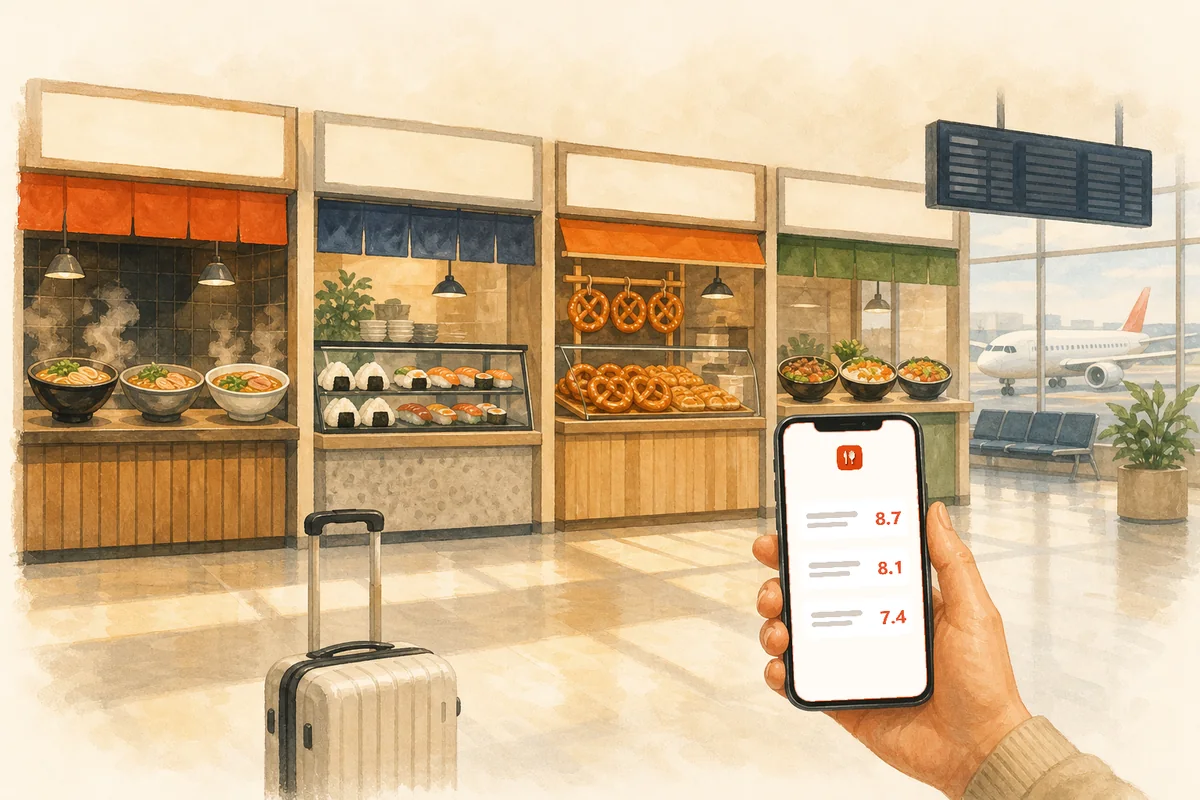
Check when boarding closes, walk past the counters once, and pick a counter that serves fast, such as a noodle bar or a bowl counter. Choose flavour you are sure about: food on the plane tastes milder, so this is the meal for something you really like. To know which dishes suit you before you queue, photograph the menu board with Taste10: it ranks the dishes for your personal taste.
The moment
You are through security at last, boarding starts in 40 minutes, and the flight is eleven hours. The meal on board comes late and tastes of not very much. Around you: a food court with a dozen counters, menu boards in two languages, prices that make you blink, and queues you cannot read from here. This is your last proper meal for half a day, it costs as much as dinner in town, and you have one go at it before the gate.
What usually goes wrong
- Panicking at the first counter and buying the familiar chain sandwich, then walking past a noodle bar you would have loved on the way to the gate.
- Sitting down at a restaurant that takes 25 minutes to bring the food, and eating it while watching the clock.
- Paying airport prices for something you do not like, and boarding hungry because there is no second try.
- Taking something messy or strong-smelling on board, and unwrapping it next to strangers in a full cabin.
How to choose your last meal before the flight
- Check your time first. Find your gate and how long the walk is, and note when boarding closes on your boarding pass. What is left is your time to eat.
- Walk past the counters once and look at the menu boards and the food on display before you join a queue.
- Pick a counter that serves fast: noodle bars, bowls, dumplings and food made in front of you are usually quicker than a sit-down restaurant.
- Choose flavour you are sure about. The meal on the plane will taste milder than on the ground (see below), so this is the meal for something you really like.
- Taking food on board? Pick something that does not smell strongly or fall apart, out of kindness to the people next to you.
Airport food abroad, and what it tastes like
| Dish | What it tastes like | Try it if you like |
|---|---|---|
| Ramen (Japan, and noodle bars at many airports) | Wheat noodles in a hot, deeply savoury broth (pork, chicken, soy or miso), with sliced pork, egg and spring onion. Rich and salty. | Chicken noodle soup, pho |
| Onigiri (Japan) | A triangle of cold rice wrapped in seaweed, with a filling such as salmon, tuna mayonnaise or salted plum. Mild, a little salty, easy to eat on the move. | Sushi, rice balls |
| Laksa (Singapore, Malaysia) | Noodles in a spicy coconut curry broth with prawns or chicken. Creamy, hot and fragrant. | Thai curry, coconut soup |
| Dim sum (Hong Kong, China) | Small steamed dumplings and buns, such as har gow with prawns or char siu bao with sweet barbecue pork. Soft, juicy and mild. | Dumplings, bao buns |
| Soft pretzel with sweet mustard (Munich, Germany) | A chewy, salty bread with a dark crust, often with sweet Bavarian mustard or butter. | Bagels, salted bread |
| Pastel de nata (Lisbon, Portugal) | A small tart of flaky pastry with a creamy egg custard, caramelised on top. Sweet and buttery. | Custard tarts, crème brûlée |
| Simit (Istanbul, Türkiye) | A ring of bread dipped in grape molasses and covered in sesame seeds. Crisp, chewy and nutty. | Sesame bagels, pretzels |
| Kaya toast (Singapore) | Toast with kaya, a sweet coconut and egg jam, and butter, often with soft-boiled eggs and soy sauce. Sweet, buttery and a little salty. | Toast with jam, French toast |
| Poke bowl (many airports) | Rice with raw marinated fish, often tuna or salmon, and toppings such as avocado, edamame and sesame. Fresh, salty and a little sweet. | Sushi, salads with fish |
| Burrito bowl (many airports) | Rice, beans, grilled meat or vegetables, salsa, cheese and sour cream. Filling, savoury, mild to spicy depending on the salsa. | Tacos, chilli con carne |
Most large airports have the same international counters (burgers, sandwiches, coffee, salads) and many add a few dishes from their own country. The table explains names you may meet on the boards abroad.
Why food tastes different on a plane
Food really does taste milder in the air. In tests for Lufthansa in a low-pressure aircraft cabin, the Fraunhofer Institute for Building Physics found that salt was perceived 20 to 30 percent less intensely and sugar 15 to 20 percent less intensely than on the ground, while fruity aromas and acids stayed more stable. Strongly flavoured Asian dishes held up well; milder dishes such as fish or poultry needed much more seasoning.
Noise plays a part too. A study at Cornell University found that loud noise like the roughly 85 decibels in a jetliner dulls sweet taste and makes umami, the savoury taste of tomato juice, stronger. That may be why so many people order tomato juice on planes and never at home. For your last meal on the ground, it means: this is the one that tastes the way it should.
Where Taste10 fits
Take a picture of a menu board, or of several counters at once, in Taste10. It ranks the dishes in the picture for your personal taste, best first, with the reason why, including dishes you have never tried. That takes seconds, so you can spend your minutes in the right queue. Then rate what you ate: on the way back, or at the next airport, Taste10 knows you a little better. The score is about your taste, not about how good the food court is.
Make the last meal before your flight count
Taste10 learns your personal taste and predicts which dishes at the airport you will enjoy most, before you join a queue.
Taste10 is in testing. Want to try it early? Get in touch.
Questions and answers
What should I eat before a long flight?
Something you know you like, from a counter that serves fast enough for your boarding time. Food tastes milder on a plane, so the last meal on the ground is the one for flavour.
Can you bring food through airport security?
In the United States, yes for solid food: the TSA allows solid food in carry-on and checked bags. Liquid or gel food over 3.4 ounces (100 ml), such as soup, yoghurt or sauces, is not allowed in carry-on bags. Rules differ by country, so check the airport you fly from.
Why does food taste different on a plane?
Low cabin pressure and dry air dull taste and smell: in tests for Lufthansa, salt tasted 20 to 30 percent weaker and sugar 15 to 20 percent weaker than on the ground. Loud cabin noise also dulls sweet taste.
Why do people drink tomato juice on planes?
Tomato juice is rich in umami, the savoury taste, and a Cornell University study found that loud noise like that in an aircraft cabin makes umami taste stronger while sweet tastes weaker. So tomato juice tastes better in the air than many other drinks.
How long before boarding should I eat at the airport?
Leave enough time to walk to the gate before boarding closes, which is shown on your boarding pass. A fast counter needs about 10 to 15 minutes to order and eat; a sit-down restaurant can take much longer.
More about taste
- How to eat well abroad as a picky eater
- What is umami?
- I'm at a night market with 30 stalls and room for three dishes
- All Real-Life Moments
Sources
- Fraunhofer Institute for Building Physics IBP: A feast for research (taste tests for Lufthansa in the flight test facility). ibp.fraunhofer.de
- Cornell Chronicle, 12 May 2015: On planes, savory tomato becomes favored flavor (Yan and Dando, Journal of Experimental Psychology: Human Perception and Performance, 2015). news.cornell.edu
- Transportation Security Administration (TSA): What can I bring? Food. tsa.gov