
What is umami? The fifth taste explained
Umami is the savoury, brothy taste of glutamate and a few related compounds. It is the fifth basic taste, alongside sweet, sour, salty and bitter. You taste it in a rich stock, aged Parmesan, ripe tomatoes, soy sauce and mushrooms. The word is Japanese and is usually translated as "pleasant savoury taste".
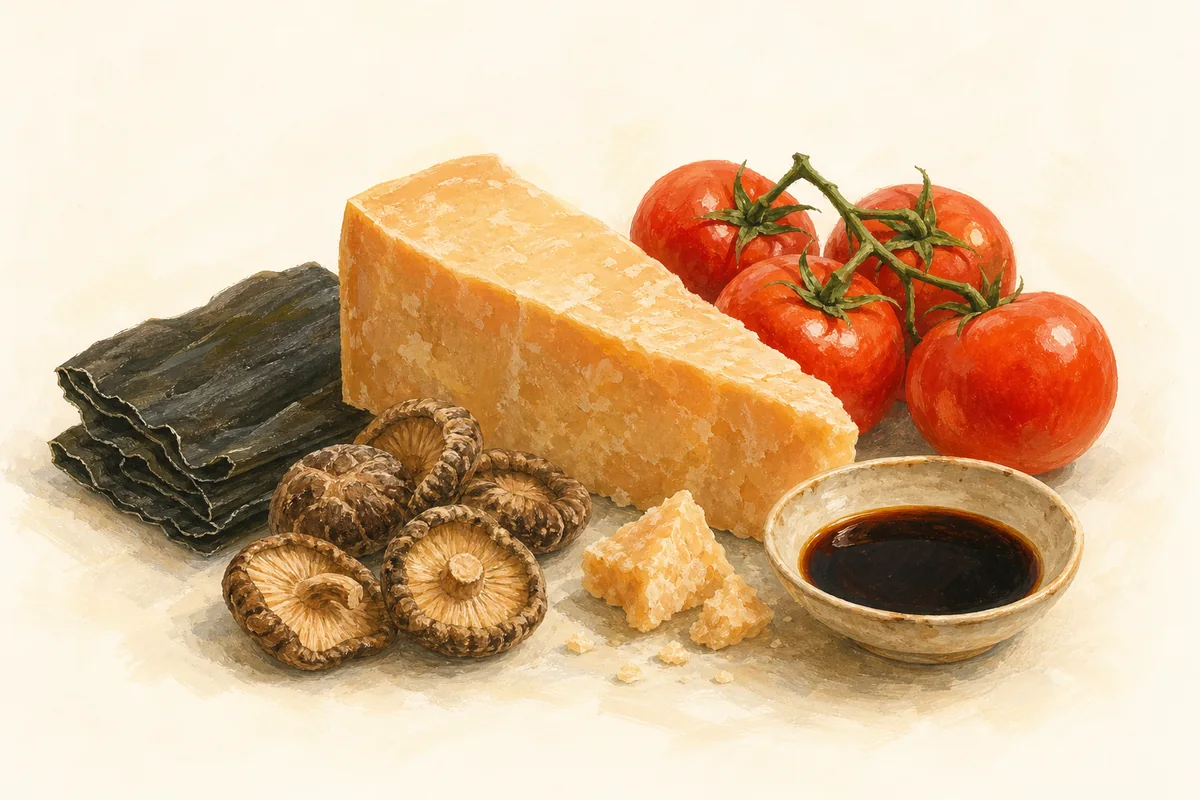
What umami tastes like
Umami is easiest to recognise by what it does to food:
- Savoury and meaty, even in food without meat, such as mushrooms or miso.
- Mouth-filling: it spreads across the whole tongue rather than hitting one spot.
- Long-lasting: it lingers after you swallow.
- Rounding: it makes other flavours taste fuller and more satisfying.
On its own, umami is surprisingly subtle. Plain glutamate in water tastes faint and a little odd. It becomes obvious in combination with salt and aroma, which is how we meet it in real food.
Where umami comes from
In 1908 the Japanese chemist Kikunae Ikeda asked why broth made from kombu, a kind of kelp, tasted so good. He found that the answer was glutamate, an amino acid, and gave the taste its name: umami.
Later research found two more umami compounds, inosinate (found in meat and fish, such as the dried bonito in Japanese stock) and guanylate (found in dried shiitake mushrooms). Combined with glutamate, they make the umami taste much stronger than either alone. That is why a stock of kombu and dried bonito, the base of Japanese cooking, tastes so intense.
For a long time, Western science counted only four basic tastes. That changed when researchers identified a receptor on the tongue that responds to glutamate, built from two proteins called T1R1 and T1R3 (Nelson and colleagues, 2002). Umami is now widely accepted as the fifth basic taste (Kurihara, 2015).
Foods rich in umami
| Group | Examples |
|---|---|
| Aged cheese | Parmesan, aged Gouda, Comté |
| Vegetables | ripe tomatoes, mushrooms (especially dried shiitake), peas, sweetcorn |
| Seaweed | kombu, nori |
| Fermented sauces and pastes | soy sauce, fish sauce, miso, Worcestershire sauce |
| Cured and dried fish and meat | anchovies, dried bonito, cured ham |
| Slow-cooked dishes | meat stocks, ramen broth, ragù |
Ageing, drying, fermenting and slow cooking all tend to increase umami: they free glutamate that was locked up in proteins. That is why a ripe tomato tastes more savoury than an unripe one, and aged cheese more than fresh.
Why umami matters for your own taste
People differ in how much they enjoy umami-rich food. Some love deep, savoury, fermented flavours such as miso, blue cheese or fish sauce; others prefer lighter, fresher food. Knowing which side you lean to explains a lot about which dishes you love and which you find heavy.
How much umami suits you?
Taste10 learns your personal taste, including how much you enjoy savoury and umami-rich food, and predicts how much you will like a product, dish or menu before you try it. Its taste portrait shows what it has learned about you.
Taste10 is in testing. Want to try it early? Get in touch.
Questions and answers
What does umami taste like?
Umami tastes savoury, brothy and meaty. It fills the mouth, lingers on the tongue and makes food taste rounder and more satisfying. A good stock, aged Parmesan or a spoonful of miso are clear examples.
Is umami the same as salty?
No. Salty is the taste of sodium; umami is the taste of glutamate and related compounds. They often appear together, in soy sauce or cured ham for example, but they are two different basic tastes picked up by different receptors.
What is MSG?
MSG, monosodium glutamate, is glutamate in the form of a salt, used as a seasoning. It tastes of umami because it contains the same glutamate that occurs naturally in tomatoes, cheese, kombu and many other foods.
Who discovered umami?
The Japanese chemist Kikunae Ikeda. In 1908 he found that glutamate gives kombu seaweed broth its distinctive taste and called that taste umami.
More about taste
- What does durian taste like?
- 15 Thai dishes explained, before you order
- Why the same food can be a 9 for you and a 3 for someone else
Sources
- Nelson, G. and colleagues (2002). An amino-acid taste receptor. Nature, 416, 199–202. doi.org/10.1038/nature726
- Kurihara, K. (2015). Umami the fifth basic taste: history of studies on receptor mechanisms and role as a food flavor. BioMed Research International, 2015, 189402. doi.org/10.1155/2015/189402