
What does durian taste like?
Durian tastes sweet, rich and creamy, like a soft custard, with savoury notes that remind many people of onion, garlic or caramel. Its smell is far stronger than its taste: fruity and sulfurous at the same time. Whether you love it or hate it depends mostly on how you react to that mix.
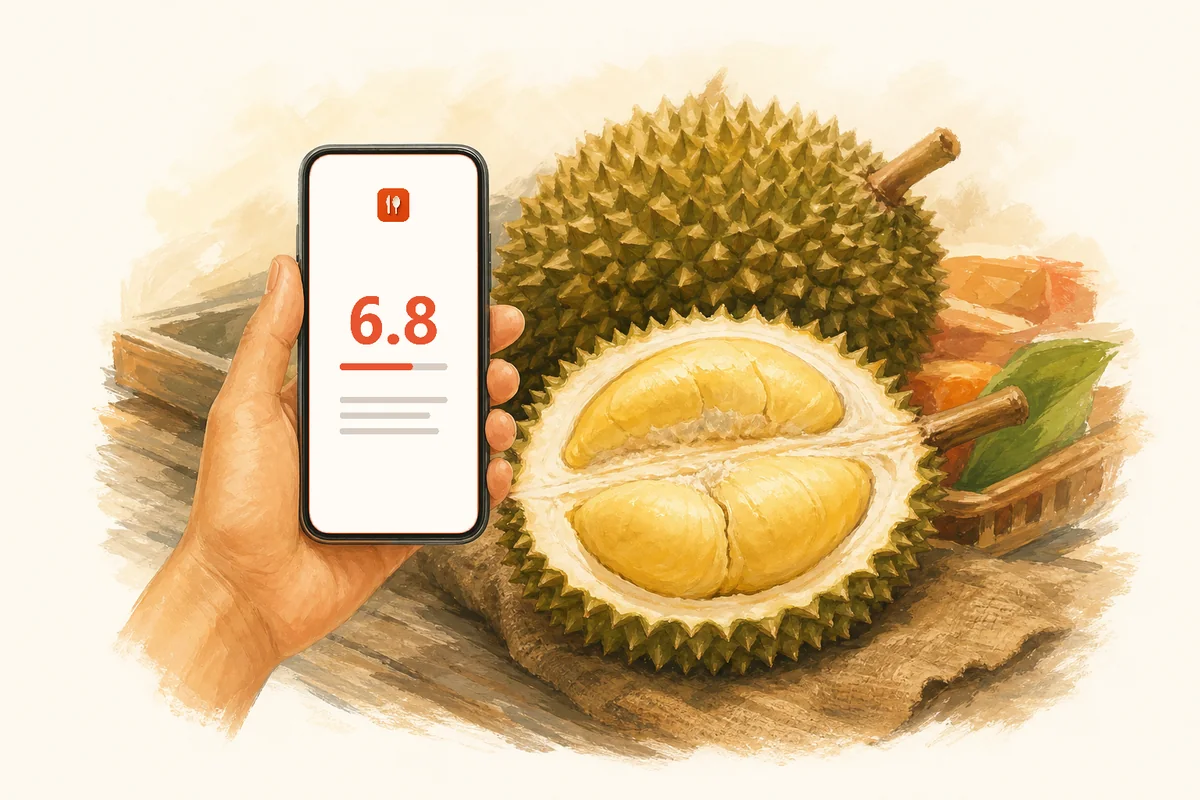
The taste of durian, in short
| Quality | What to expect |
|---|---|
| Sweetness | High, like custard or caramel |
| Savoury depth | Noticeable: hints of onion, garlic or a ripe soft cheese |
| Sourness | Very little |
| Texture | Soft, creamy and custard-like, sometimes a little fibrous |
| Smell | Very strong: fruity and sulfurous at once |
Why durian smells so strong
Durian's smell comes from a mix of fruity and sulfur-containing compounds. In a study of the Thai Monthong variety, food chemists found that just two of them, in the amounts found in the fruit, were enough to recreate the typical durian smell: one fruity, one reminiscent of roasted onion (Li, Schieberle and Steinhaus, 2017).
That pairing explains the split reaction. Some people notice mainly the fruity, sweet side. Others notice mainly the oniony, sulfurous side, and for them durian smells like something gone off.
What durian's texture is like
The edible part is the pale yellow flesh around large seeds, inside a thick, spiky husk. It is soft enough to eat with a spoon, smooth like a thick custard, and it melts in the mouth. Very ripe durian is softer and tastes stronger; less ripe durian is firmer and milder.
Why people love it or hate it
- The smell comes first. Durian is usually smelled before it is tasted, and a strong first impression sets the tone.
- People react differently to sulfur notes. The same compounds that some find savoury and appetising, others find unpleasant.
- Familiarity matters. In much of Southeast Asia durian is a treasured seasonal fruit, often called the "king of fruits". People who grew up with it tend to judge it very differently from first-timers.
You may enjoy durian if you like
- rich, sweet custards, crème caramel or vanilla pudding;
- ripe soft cheeses with a strong, funky note;
- sweet, slowly cooked onions;
- other soft, sweet tropical fruits such as ripe jackfruit.
If you dislike strong smells in food, or sweet and savoury flavours together, durian is more likely to be a miss for you.
Trying durian for the first time
- Start small. One piece of flesh is enough to know where you stand.
- Try it as a sweet first, if you are unsure. Durian ice cream, cakes and sweets carry the flavour in a smaller dose.
- Know your variety. Thailand's Monthong is the most widely exported and is often described as milder and sweeter. Malaysia's Musang King is prized for a richer, deeper and slightly bitter-sweet taste.
- Eat it where it is welcome. Singapore has kept durian off its MRT trains since 1988, and many hotels in Southeast Asia do not allow it in rooms. Markets and durian stalls are the classic place to try it.
Will you like it? Ask about your own taste
Durian shows why an average rating tells you little: for one person it is a 9, for another a 2. Taste10 learns your personal taste and predicts how much you will enjoy a food before you try it, with the reason why. Photograph a durian, a durian sweet or a whole menu and see your own score.
Taste10 is in testing. Want to try it early? Get in touch.
Questions and answers
Does durian taste like it smells?
Not really. The smell is much stronger and more sulfurous than the taste. In the mouth, the sweet and creamy side comes first, and the oniony notes are softer. Many people who dislike the smell are surprised by the taste.
Is durian sweet?
Yes. Ripe durian is clearly sweet, often compared to custard, caramel or vanilla pudding, with a savoury depth underneath. It is not sour.
What does durian taste similar to?
There is no exact match. People most often compare it to sweet custard or crème caramel with a hint of onion, garlic or a ripe, soft cheese. Some describe it as a fruit that tastes like a dessert and a savoury dish at once.
Why is durian not allowed in some places?
Because of its smell, which spreads and lingers. Singapore has kept durian off its MRT trains since 1988, and many hotels in Southeast Asia do not allow it in rooms.
More about taste
- What is umami? The fifth taste explained
- 15 Thai dishes explained, before you order
- Why the same food can be a 9 for you and a 3 for someone else
Sources
- Li, J.-X., Schieberle, P. and Steinhaus, M. (2017). Insights into the key compounds of durian (Durio zibethinus L. 'Monthong') pulp odor by odorant quantitation and aroma simulation experiments. Journal of Agricultural and Food Chemistry, 65(3), 639–647. doi.org/10.1021/acs.jafc.6b05299
- Mothership (May 2025), on the durian ban on Singapore's public transport and in hotels. mothership.sg