
What is the Scoville scale? Chilli heat from mild to extreme
The Scoville scale measures how hot a chilli pepper is, in Scoville heat units (SHU): a bell pepper has 0, a jalapeño 2,500 to 10,000, a habanero 100,000 to 350,000 and the record holder, Pepper X, about 2.7 million. The higher the number, the more capsaicin, the compound that makes chilli burn. It tells you how hot a chilli is, but not how much you will enjoy that heat.
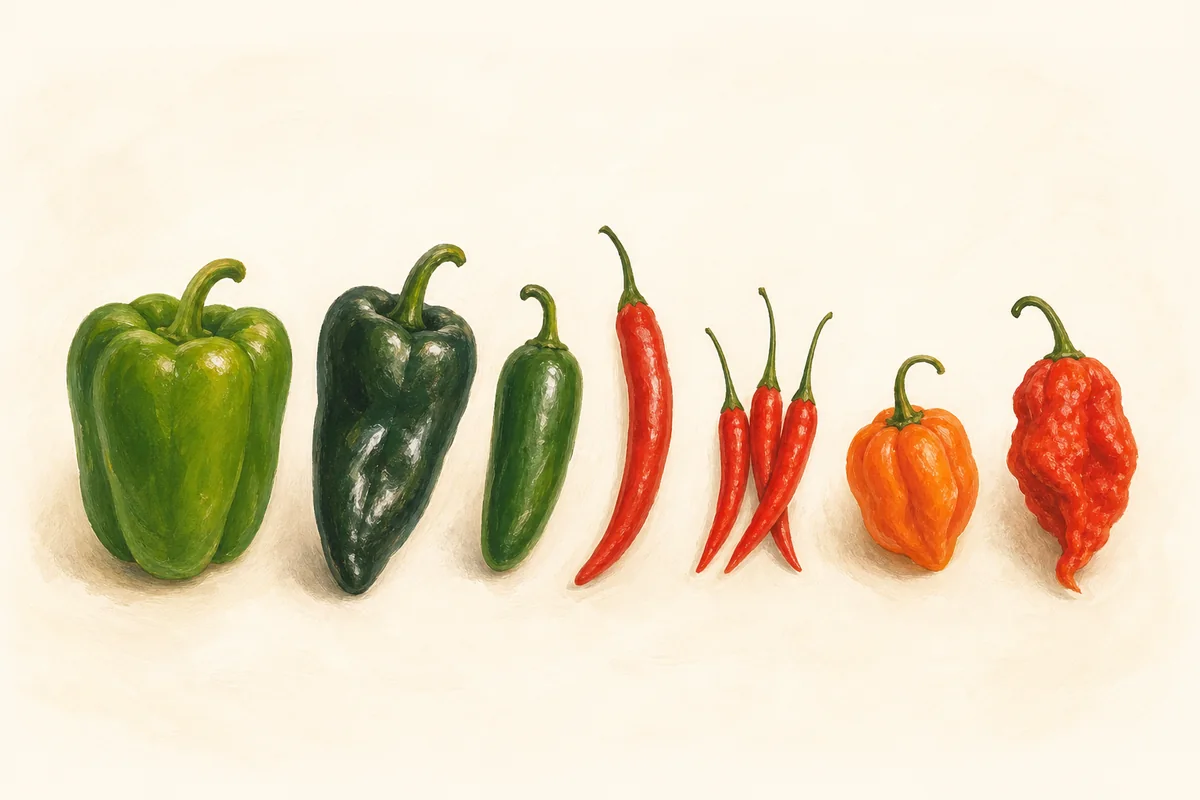
The Scoville scale chart: how hot is each chilli?
The numbers are typical ranges. A single chilli can sit well above or below them, because heat depends on how and where the plant was grown.
| Chilli | Scoville heat units (SHU) | Heat for most people |
|---|---|---|
| Bell pepper | 0 | No heat |
| Poblano | 1,000 to 2,500 | Mild |
| Jalapeño | 2,500 to 10,000 | Mild to medium |
| Serrano | 10,000 to 25,000 | Medium |
| Cayenne | 25,000 to 50,000 | Hot |
| Thai bird's eye | 50,000 to 100,000 | Hot |
| Habanero | 100,000 to 350,000 | Very hot |
| Scotch bonnet | 100,000 to 350,000 | Very hot |
| Ghost pepper (bhut jolokia) | about 1,000,000 | Extreme |
| Carolina Reaper | about 1,640,000 on average | Extreme |
| Pepper X | about 2,693,000 on average | Extreme (the record) |
| Pure capsaicin | 16,000,000 | The top of the scale |
How the Scoville scale works
The scale is named after Wilbur Scoville, an American pharmacist who described the method in 1912.
- Extract the heat. A dried chilli is soaked in alcohol, which draws out the compounds that make it hot.
- Dilute it in sugar water, step by step.
- Let a panel of tasters try each step until most of them can no longer feel any heat.
- Count the dilution. If the extract had to be diluted 5,000 times before the heat disappeared, the chilli rates 5,000 Scoville heat units.
Because it relied on people's tongues, the original test was subjective. Today laboratories use a machine method called high-performance liquid chromatography (HPLC), which measures the heat compounds directly. The result is then converted into Scoville heat units, so the familiar numbers stayed.
Why chilli heat is not a taste
The heat comes mainly from capsaicin. It does not work on taste buds the way sugar or salt does. Instead it switches on a sensor in your nerve endings called TRPV1, the same sensor that reacts to painfully hot temperatures. That is why chilli feels like burning rather than like a flavour, and why it also stings on your lips, your skin or in your eyes. David Julius received a share of the 2021 Nobel Prize in Physiology or Medicine for discovering this sensor, using capsaicin to find it.
Why the same chilli can be milder or hotter
- Growing conditions. Light, temperature and water all change how much capsaicin a plant makes. Researchers at New Mexico State University found that a mild variety gets hotter when the plant is stressed in the field.
- Where you bite. The heat sits mostly in the pale inner tissue that holds the seeds, not in the seeds themselves. Cutting that tissue out makes a chilli noticeably milder.
- Ripeness and variety. Two chillies with the same name, from different farms, can be far apart on the scale.
Why the same heat feels different to different people
The Scoville number measures the chilli, not your mouth. A dish one person calls pleasantly warm can be overwhelming for the next. Plenty of people seek out the burn and enjoy it, others avoid even a mild jalapeño, and both are normal. How much heat you enjoy is part of your personal taste, a bit like an acquired taste.
What helps when a dish is too hot
In a 2019 study, 72 people drank spicy tomato juice and then tried different drinks to cool their mouths. Every drink reduced the burn somewhat, but whole milk and skimmed milk worked best, followed by a sweet fruit drink. Because skimmed milk did about as well as whole milk, the researchers think the protein in milk matters more than the fat.
How hot is too hot for you?
Some people love the burn of a habanero, others stop at a jalapeño. Taste10 learns your personal taste and predicts how much you will enjoy a dish before you order it, with the reason why.
Taste10 is in testing. Want to try it early? Get in touch.
Questions and answers
What does SHU stand for?
SHU stands for Scoville heat units, the unit of the Scoville scale. A bell pepper has 0 SHU, a jalapeño 2,500 to 10,000 and pure capsaicin 16 million.
How hot is a jalapeño on the Scoville scale?
A jalapeño usually rates 2,500 to 10,000 Scoville heat units: mild to medium. A habanero is many times hotter.
What is the hottest pepper in the world?
Pepper X, bred by Ed Currie in the United States, is the Guinness World Records holder since October 2023, at an average of 2,693,000 Scoville heat units. The previous record holder was the Carolina Reaper, at about 1.64 million.
How hot is a ghost pepper?
A ghost pepper (bhut jolokia) rates about 1 million Scoville heat units, a hundred times or more the heat of a typical jalapeño.
Are the seeds the hottest part of a chilli?
No. The heat sits mostly in the pale inner tissue the seeds grow on. The seeds taste hot because they touch it.
Does milk help with spicy food?
Yes. In a study of 72 people, whole and skimmed milk reduced the burn of chilli more than water, cola, sparkling water or beer without alcohol.
More about taste
- 15 popular Thai dishes explained, before you order
- Mexican dishes beyond tacos
- Korean dishes explained: a first-timer's guide to the menu
- Acquired taste: meaning, examples and why tastes change
Sources
- Bosland, P.W. and Walker, S.J. Measuring Chile Pepper Heat. Guide H-237, New Mexico State University (2010). pubs.nmsu.edu/_h/H237
- Hottest chile peppers tested by the Chile Pepper Institute. New Mexico State University. cpi.nmsu.edu/chile-info/heat.html
- The Nobel Prize in Physiology or Medicine 2021, press release. Nobel Prize Outreach. nobelprize.org
- Pepper X dethrones Carolina Reaper as world’s hottest chilli pepper. Guinness World Records, 16 October 2023. guinnessworldrecords.com
- Nolden, A.A., Lenart, G. and Hayes, J.E. Putting out the fire: efficacy of common beverages in reducing oral burn from capsaicin. Physiology & Behavior (2019). pubmed.ncbi.nlm.nih.gov/31121171
- Al Othman, Z.A. et al. Determination of capsaicin and dihydrocapsaicin in Capsicum fruit samples using high performance liquid chromatography. Molecules, 16(10), 8919 (2011). pmc.ncbi.nlm.nih.gov/articles/PMC6264681
- Scoville scale, typical ranges by pepper (with their original sources). Wikipedia. en.wikipedia.org/wiki/Scoville_scale