
A first-timer's guide to a Korean menu
Korean food combines savoury, sweet, sour and spicy flavours, with garlic, sesame, soy sauce and fermented chilli paste at its heart. Many dishes are shared, and a meal comes with free side dishes. Here are 12 dishes you will find on most Korean menus, what they taste like, and which ones are spicy.
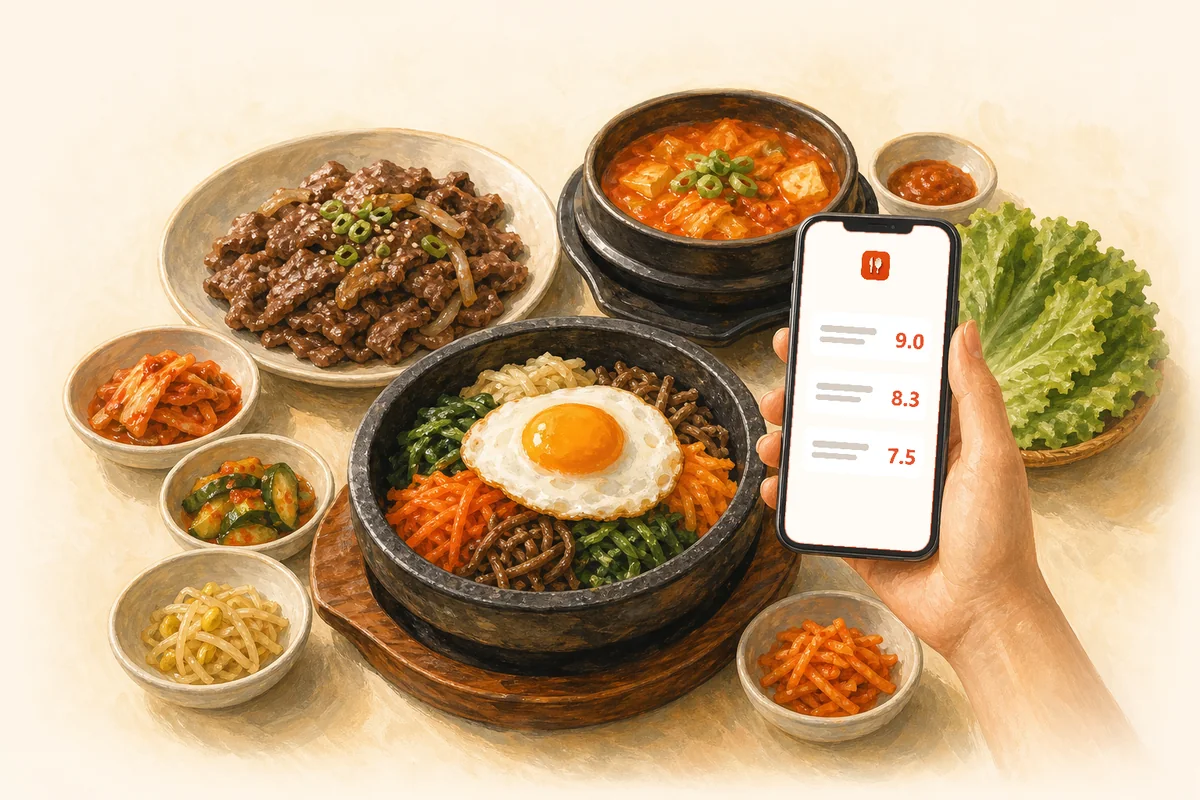
Heat is a guide only: restaurants differ, and many dishes can be made milder if you ask. Korean names are given in Korean script too, which helps with a menu that has no English.
Rice and noodles
1. Bibimbap 비빔밥
Rice topped with vegetables, beef, a fried egg and chilli paste, mixed together at the table; in a hot stone bowl the rice turns crisp at the bottom. Savoury, fresh and mildly spicy. Usual heat: mild to medium, you add the chilli paste yourself.
2. Japchae 잡채
Glass noodles made from sweet potato starch, stir-fried with vegetables and beef in soy sauce and sesame oil. Sweet-savoury, glossy and chewy. Not spicy.
3. Naengmyeon 냉면
Thin, chewy buckwheat noodles in an icy, tangy beef broth, a summer classic. Cold, refreshing, tangy and slightly sweet. The plain version is not spicy; the version mixed with chilli sauce is.
Grill and barbecue
4. Bulgogi 불고기
Thin slices of beef marinated in soy sauce, sugar, garlic and sesame oil, then grilled. Sweet, savoury and tender. Not spicy.
5. Galbi 갈비
Marinated beef or pork short ribs, grilled at the table. Sweet, smoky and rich. Not spicy.
6. Samgyeopsal 삼겹살
Thick slices of pork belly grilled at the table and wrapped in lettuce with garlic and a savoury dip. Rich, crisp and fatty, freshened by the lettuce. Not spicy.
7. Korean fried chicken 치킨
Twice-fried chicken, plain and crisp or coated in a sweet-spicy glaze. Very crisp. The glazed kind is sweet, sticky and medium-hot.
Stews and soups
8. Kimchi stew (kimchi jjigae) 김치찌개
A bubbling stew of well-aged kimchi with pork or tuna and tofu. Sour, spicy and deeply savoury. Usual heat: medium to hot.
9. Soft tofu stew (sundubu jjigae) 순두부찌개
Silky soft tofu in a red, chilli-based broth, often with seafood and an egg cracked in. Silky, savoury and spicy. Usual heat: medium to hot, and you can often choose.
Sharing dishes
10. Tteokbokki 떡볶이
Chewy rice cakes simmered in a thick, red chilli sauce, Korea's favourite street food. Sweet, spicy and very chewy. Usual heat: medium to hot.
11. Seafood pancake (haemul pajeon) 해물파전
A large savoury pancake full of spring onions and seafood, cut into pieces and dipped in soy sauce. Crisp edges, soft middle, savoury. Not spicy.
12. Side dishes (banchan) 반찬
The small dishes that arrive with your meal, such as kimchi, seasoned spinach and soy-braised potatoes. They are usually free and refilled. Everything from mild and sweet to sour and spicy: try a little of each.
Which of these would you like most?
A guide tells you what each dish tastes like. Taste10 tells you how much you will enjoy it. Photograph a Korean menu, even one written only in Korean, and see the dishes ranked for your own taste, with the reason why.
Taste10 is in testing. Want to try it early? Get in touch.
Questions and answers
Which Korean dishes are not spicy?
Bulgogi, galbi, samgyeopsal, japchae and seafood pancake are usually not spicy. Bibimbap is only as spicy as the amount of chilli paste you add.
What are the small free dishes at a Korean meal?
They are called banchan: side dishes such as kimchi, seasoned vegetables and braised potatoes. They are usually included and refilled when you ask.
How do I ask for a dish that is not spicy in Korean?
You can say "an maepge haejuseyo", which means "please make it not spicy". Not every dish can be changed, but many can.