
What is an acquired taste, and why do tastes change?
An acquired taste is a food or drink that most people dislike at first and learn to like only after trying it several times, such as black coffee, olives, blue cheese or very dark chocolate. Repeated tasting makes the unfamiliar feel safe and familiar, and many people end up loving what they once rejected.
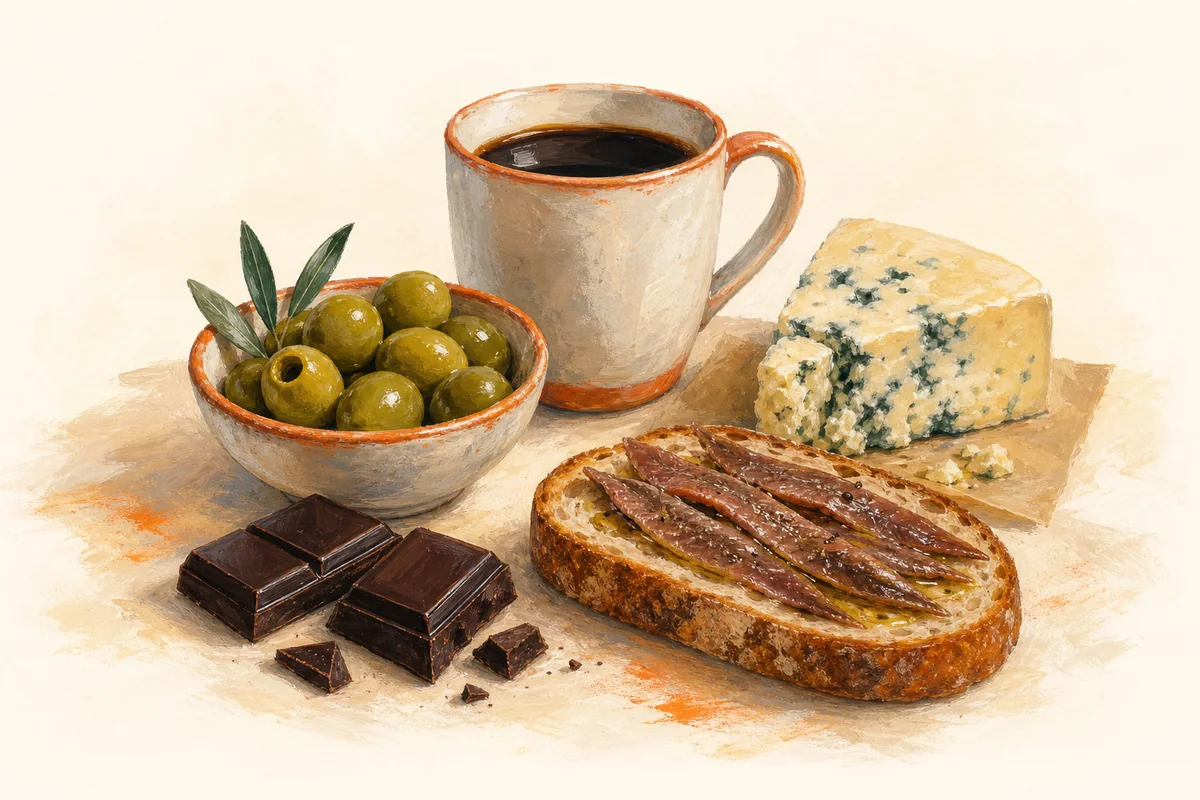
Why some foods are an acquired taste
- Bitterness: people are wary of bitter tastes from the start, so coffee, dark chocolate and bitter greens often need time.
- Strong smells: blue cheese, fermented fish and durian can smell like something has gone off.
- Unusual textures: oysters, natto or okra feel strange before they taste good.
- Unfamiliarity: anything far from the food we grew up with needs a few tries.
Why tasting again works
Liking grows with exposure. In a classic study, young children were offered unfamiliar foods again and again, and the more often they had tasted a food, the more they liked it (Birch and Marlin, 1982). Adults work the same way: each try makes a food more familiar, and familiar food tastes better to us.
Common acquired tastes
| Food or drink | What makes it hard at first |
|---|---|
| Black coffee | Bitterness |
| Olives | Bitterness and saltiness |
| Blue cheese | Strong smell and sharpness |
| Very dark chocolate | Bitterness, little sweetness |
| Anchovies | Intense saltiness and fishiness |
| Natto | Smell and sticky texture |
| Coriander | A soapy taste for some people |
Why tastes change over a lifetime
Children tend to prefer sweet and avoid bitter. As we grow up, try more foods and eat in new places, many of us come to enjoy flavours we once avoided. Habits, culture and the people we eat with all shape it, which is why your taste today may be quite different from your taste ten years ago.
How to acquire a taste
- Start small, with a little alongside food you already like.
- Try a milder version first: a milky coffee before an espresso, a creamy blue cheese before a sharp one.
- Try it more than once. A single bad first impression says little.
How does it fit your own taste?
Your taste changes as you try new things. Taste10 learns your personal taste from what you tell it and from your ratings of what you actually tried, so its predictions keep up with you.
Taste10 is in testing. Want to try it early? Get in touch.
Questions and answers
What is an example of an acquired taste?
Black coffee, olives, blue cheese, very dark chocolate and anchovies are classic examples: many people dislike them at first and like them later.
How many times do you need to try a food to like it?
There is no fixed number, but research with children suggests that liking often grows after repeated tasting, sometimes ten or more times.
Why do tastes change as we get older?
Repeated exposure, new experiences, culture and habit all shape what we enjoy, so many people come to like flavours they avoided as children.
More about taste
- Why does coriander taste like soap to some people?
- Why do fermented foods taste the way they do?
- Why the same food can be a 9 for you and a 3 for someone else
Sources
- Birch, L. L. and Marlin, D. W. (1982). I don't like it; I never tried it: effects of exposure on two-year-old children's food preferences. Appetite, 3(4), 353–360. doi.org/10.1016/S0195-6663(82)80053-6