
Why does coriander taste like soap to some people?
Coriander leaves contain aromatic compounds called aldehydes, some of which are also found in soap. People who are especially sensitive to them taste soap; others mainly taste something fresh, green and citrusy. Part of the difference is genetic, and part is how familiar coriander is from the food someone grew up with.
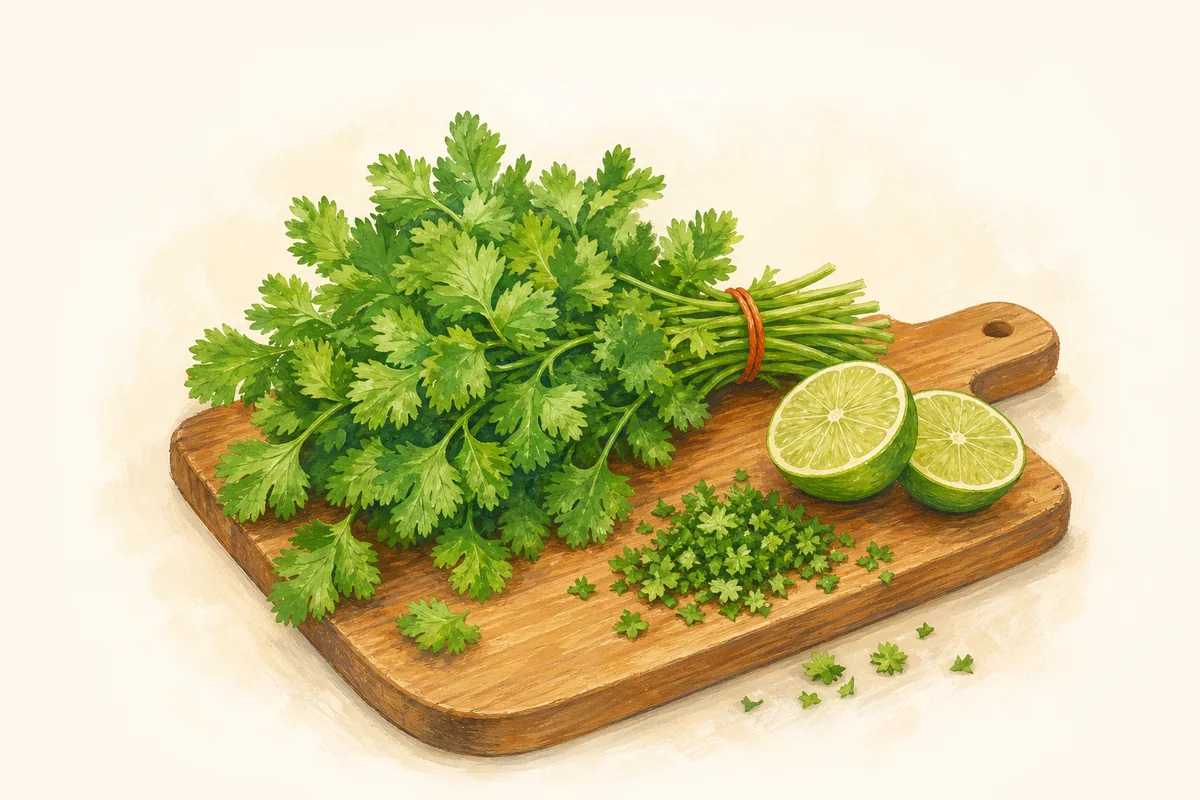
What coriander tastes like
To most people who like it, coriander leaves taste fresh, green, slightly peppery and a little like citrus peel. To people who dislike it, the same leaves taste soapy, metallic or even like bugs. Both groups are describing the same leaves accurately: they perceive them differently.
Where the soapy taste comes from
The smell of coriander leaves comes largely from aldehydes, aromatic compounds such as decenal. Similar compounds are used in soaps and lotions. If your nose picks these up strongly, the soap-like side of coriander is what you notice first.
The role of genes
A large genetic study found that a variant near a group of smell receptor genes, including one that is sensitive to aldehydes, is linked to whether people find coriander soapy (Eriksson and colleagues, 2012). The effect is real but small: genes explain only part of who dislikes coriander.
How common it is
A study of about 1,400 young adults in Canada found that how many people dislike coriander varies widely between backgrounds (Mauer and El-Sohemy, 2012):
| Background | Share who disliked coriander |
|---|---|
| East Asian | 21% |
| Caucasian | 17% |
| South Asian | 7% |
| Hispanic | 4% |
| Middle Eastern | 3% |
The groups whose cooking uses coriander the most disliked it the least, which suggests that familiarity matters as much as genes.
Can you learn to like coriander?
- Try it crushed or chopped finely. Crushing the leaves helps enzymes break down the aldehydes, which can make the soapy note fainter.
- Try it cooked, for example stirred into a curry or soup, where it tastes softer than raw.
- Try it repeatedly in small amounts. Many tastes become more pleasant with familiarity.
How does it fit your own taste?
Whether coriander lifts a dish or ruins it for you is personal. Taste10 learns your personal taste, including the flavours that split people, and predicts how much you will enjoy a dish before you order it, with the reason why.
Taste10 is in testing. Want to try it early? Get in touch.
Questions and answers
Why does coriander taste like soap?
Coriander leaves contain aldehydes, aromatic compounds that are also found in soaps. People who are sensitive to them notice that soapy side most.
Is disliking coriander genetic?
Partly. A genetic variant near smell receptor genes is linked to finding coriander soapy, but it explains only part of the difference. Familiarity matters too.
Is coriander the same as cilantro?
Yes. In British English the leaves are called coriander; in American English the leaves are called cilantro and the seeds coriander.
More about taste
- What is umami? The fifth taste explained
- What is an acquired taste, and why do tastes change?
- Why the same food can be a 9 for you and a 3 for someone else
Sources
- Eriksson, N. and colleagues (2012). A genetic variant near olfactory receptor genes influences cilantro preference. Flavour, 1, 22. doi.org/10.1186/2044-7248-1-22
- Mauer, L. and El-Sohemy, A. (2012). Prevalence of cilantro (Coriandrum sativum) disliking among different ethnocultural groups. Flavour, 1, 8. doi.org/10.1186/2044-7248-1-8
- Compound Interest (2014), on the chemistry of coriander. compoundchem.com