
What do rare, medium and well done mean? Steak doneness explained, level by level
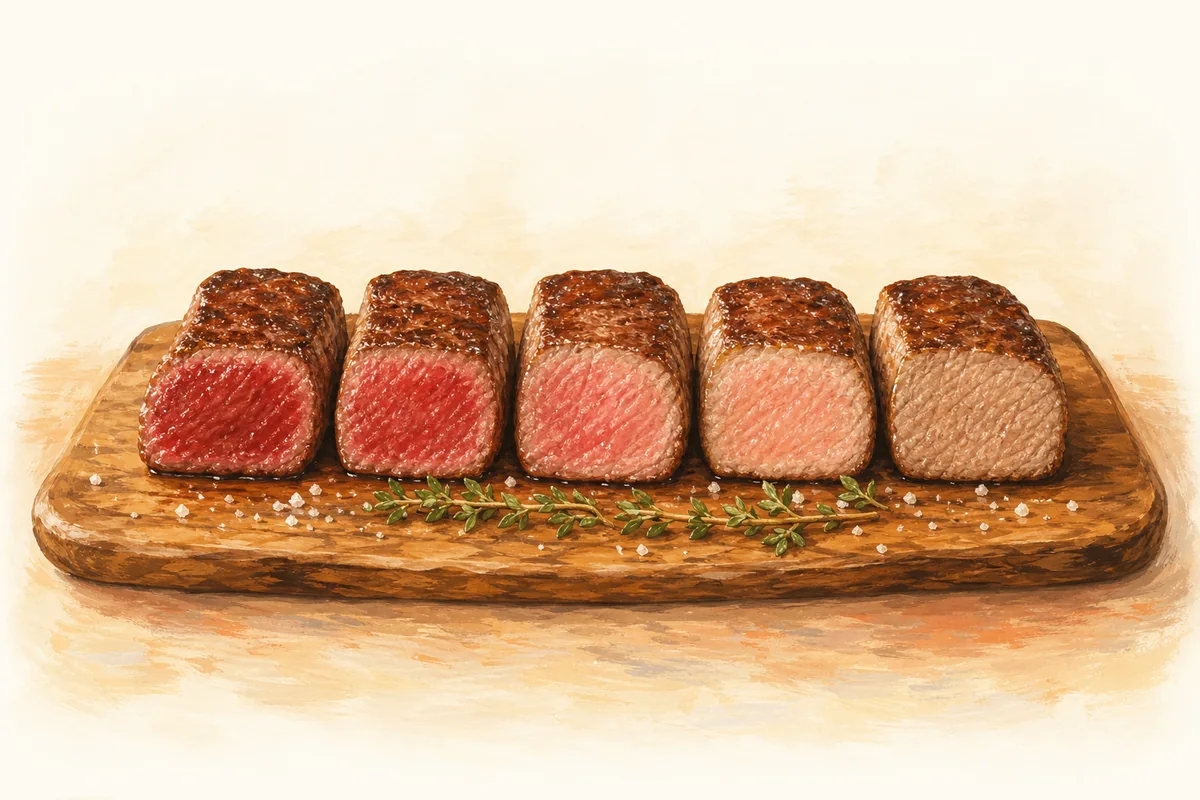
Steak doneness is how far a steak is cooked through, judged by its centre: red and soft when rare, rosy and juicy at medium rare, pink and firmer at medium, brown-grey and firm when well done. Each step up makes a steak firmer and less juicy, and the beef flavour is strongest around rare to medium. None of them is wrong: it is a matter of personal taste. To find the steak dish you will enjoy most on a menu, Taste10 predicts it for your personal taste.
What is steak doneness?
Doneness is how far a steak is cooked through, judged by the colour and temperature at its centre. The usual scale runs from very rare, also called blue, through rare, medium rare, medium and medium well to well done. The outside is browned at every level; what changes is the middle.
The red you see is not blood. According to the US Department of Agriculture, most of the red colour of meat comes from myoglobin, a protein fixed in the muscle cells that does not circulate in the blood. Heat changes it, which is why the centre turns from red to pink to brown-grey as a steak cooks.
Steak doneness chart: from blue to well done
The temperatures below are the ones meat scientists use when they test steaks, taken from the Beef Steak Color Guide of the US National Cattlemen's Beef Association (as used by Drey and others, 2019). Medium well sits between medium and well done. The texture and taste column is a rough guide: every steak varies with its cut and thickness.
| Doneness | Centre | Texture and taste | Core temperature |
|---|---|---|---|
| Very rare (blue) | Deep red, cool to warm | Very soft and wet; mild, almost raw beef flavour | 55 °C / 131 °F |
| Rare | Red, warm | Soft and very juicy; full beef flavour | 60 °C / 140 °F |
| Medium rare | Rosy red to pink | Tender and juicy, a little firmer; the fat starts to soften | 63 °C / 145 °F |
| Medium | Pink band in the middle | Firmer and less juicy; a rounder, roasted flavour | 71 °C / 160 °F |
| Well done | Brown-grey, little or no pink | Firm and drier; the flavour of the crust and any sauce leads | 77 °C / 170 °F |
| Very well done | Brown-grey throughout | Firm, dry and chewy unless the cut is fatty | 82 °C / 180 °F |
Charts do not agree to the degree. The US beef industry's own cooking site calls 145 °F medium rare, 160 °F medium and 170 °F well done, while many cooking charts online put each level a few degrees lower. So a medium rare in one restaurant can look like another's medium. For whole cuts of beef, the US Department of Agriculture's minimum internal temperature is 145 °F (62.8 °C) with a rest of at least three minutes.
How doneness changes the taste and texture
A study at Kansas State University cooked strip steaks of five quality grades to all six levels in the chart and had 360 consumers and a trained panel taste them (Drey and others, 2019). Three findings help when you order:
- Tenderness holds up to medium rare, then drops. The trained panel found very rare, rare and medium rare equally tender; medium was tougher, and well done and very well done tougher still.
- The beef flavour is strongest in the middle of the scale. Rare and medium steaks had the most beef flavour; very rare and the well done levels had the least.
- Every step up costs juiciness. Consumers rated steaks lower as doneness went up, whatever the grade of the beef.
Even people who like their steak well done notice the difference. In an earlier study, 315 consumers each tasted beef fillet cooked to the doneness they prefer. Those who ate it well done rated it less juicy than those who ate it very rare or medium rare (O'Quinn and others, 2015). Well done is not a mistake; it simply trades juiciness for firmness and a browner flavour.
Rare vs medium rare, and medium rare vs medium
These two steps are where most people hesitate, and where most diners settle.
| Rare vs medium rare | Medium rare vs medium | |
|---|---|---|
| Colour | Red centre vs rosy pink centre | Rosy pink centre vs a pink band with brown around it |
| Texture | Both soft; medium rare a touch firmer | Medium is noticeably firmer |
| Juiciness | Both very juicy | Medium is less juicy |
| Good for | Lean cuts such as fillet, if you like it soft | Medium: marbled cuts such as ribeye stay juicier |
Which cut suits which doneness?
The fat in the meat matters more the further you cook it. In the Kansas State study, the best-marbled beef (USDA Prime) was rated only 8 to 18 percent juicier than lean beef (Select) at medium rare and below, but 38 to 123 percent juicier at medium and above. The authors call marbling "insurance" for juiciness at high doneness (Drey and others, 2019).
- If you like it rare or medium rare: lean, tender cuts such as fillet (tenderloin) and sirloin do well.
- If you like it medium or well done: choose a marbled cut such as ribeye (entrecôte), which stays juicier as it cooks through.
Why people disagree about the right doneness
There is no correct level, only a personal one. In a study of 2,212 households in four US cities, people in San Francisco and Philadelphia cooked their steaks less than people in Chicago and Houston. Overall liking was highest for steaks cooked medium rare or less (Lorenzen and others, 1999). Where you live and what you are used to seem to shape the answer, much as with gamey meat.
How to order your steak the way you like it
- Say what you want to see, not only the word. "Medium rare, pink in the middle" is clearer than "medium rare" alone, because restaurants draw the lines differently.
- Not sure? Start with medium rare. It is tender and juicy, and the kitchen can always cook it a little more. A steak cannot be uncooked.
- Want it well done? Pick a fatty cut. A ribeye stays juicier than a fillet at that level.
- Sharing? Order two levels. Tasting both side by side is the fastest way to learn where you stand.
Taste10 cannot tell you how the kitchen will cook your steak. What it can do is predict how much you will enjoy each steak dish on the menu, a ribeye with peppercorn sauce or a fillet with béarnaise, for your personal taste, so you choose the dish first and the doneness second.
Ribeye or fillet: which will you enjoy?
Taste10 learns your personal taste and predicts how much you will enjoy each dish on a menu before you order, with the reason why.
Taste10 is in testing. Want to try it early? Get in touch.
Questions and answers
What is medium rare?
Medium rare is a steak with a warm, rosy red to pink centre and browned outside, cooked to a core of about 63 °C (145 °F) on the scale meat scientists use. It is tender and juicy, a little firmer than rare.
What is the difference between medium rare and medium?
Medium rare has a rosy red to pink centre and stays tender and very juicy. Medium has a narrower pink band with brown around it, and is firmer and less juicy.
What is a blue steak?
A blue steak, also called very rare, is seared on the outside and deep red and barely warm inside, at about 55 °C (131 °F) at its core. It is the softest level, with the mildest beef flavour.
Is the red juice in a rare steak blood?
No. According to the US Department of Agriculture, most of the red colour of meat comes from myoglobin, a protein in the muscle cells that does not circulate in the blood.
Is well done steak bad?
No, it is a preference. Studies find well done steaks firmer and less juicy on average, so a marbled cut such as ribeye suits that level better than a lean fillet.
Which steak doneness has the most flavour?
In a 2019 study at Kansas State University, a trained panel found the most beef flavour in steaks cooked rare and medium, and the least in very rare and well done ones.
More about taste
- What does gamey mean? The gamey taste explained, meat by meat
- What is mouthfeel? Meaning, food texture words and examples
- How to decide what to order at a restaurant
- I'm on a first date and can't decide what to order
- I'm at a business dinner abroad and don't recognise anything on the menu
Sources
- US Department of Agriculture, Food Safety and Inspection Service: The color of meat and poultry. fsis.usda.gov
- US Department of Agriculture, Food Safety and Inspection Service: Safe minimum internal temperature chart. fsis.usda.gov
- Cattlemen's Beef Board and National Cattlemen's Beef Association: Determining doneness. beefitswhatsfordinner.com
- Drey, L.N. et al. Evaluation of marbling and enhancement's abilities to compensate for reduced beef palatability at elevated degrees of doneness. Journal of Animal Science, 97(2), 669-686 (2019). pmc.ncbi.nlm.nih.gov/articles/PMC6358232
- O'Quinn, T.G., Brooks, J.C. and Miller, M.F. Consumer assessment of beef tenderloin steaks from various USDA quality grades at 3 degrees of doneness. Journal of Food Science, 80(2), S444-S449 (2015). pubmed.ncbi.nlm.nih.gov/25597832
- Lorenzen, C.L. et al. Beef customer satisfaction: cooking method and degree of doneness effects on the top loin steak. Journal of Animal Science, 77(3), 637-644 (1999). pubmed.ncbi.nlm.nih.gov/10229359