
What does gamey mean? The gamey taste explained, meat by meat
Gamey describes a strong, earthy, slightly wild flavour and smell in meat, stronger than the beef, chicken and pork most people eat every day. The word comes from game such as venison and wild boar, and is also used for lamb, mutton, goat and duck. The flavour sits mostly in the fat and grows with the animal's age and a diet of pasture. Whether it is a pleasure or a reason to leave the plate depends on who is eating.
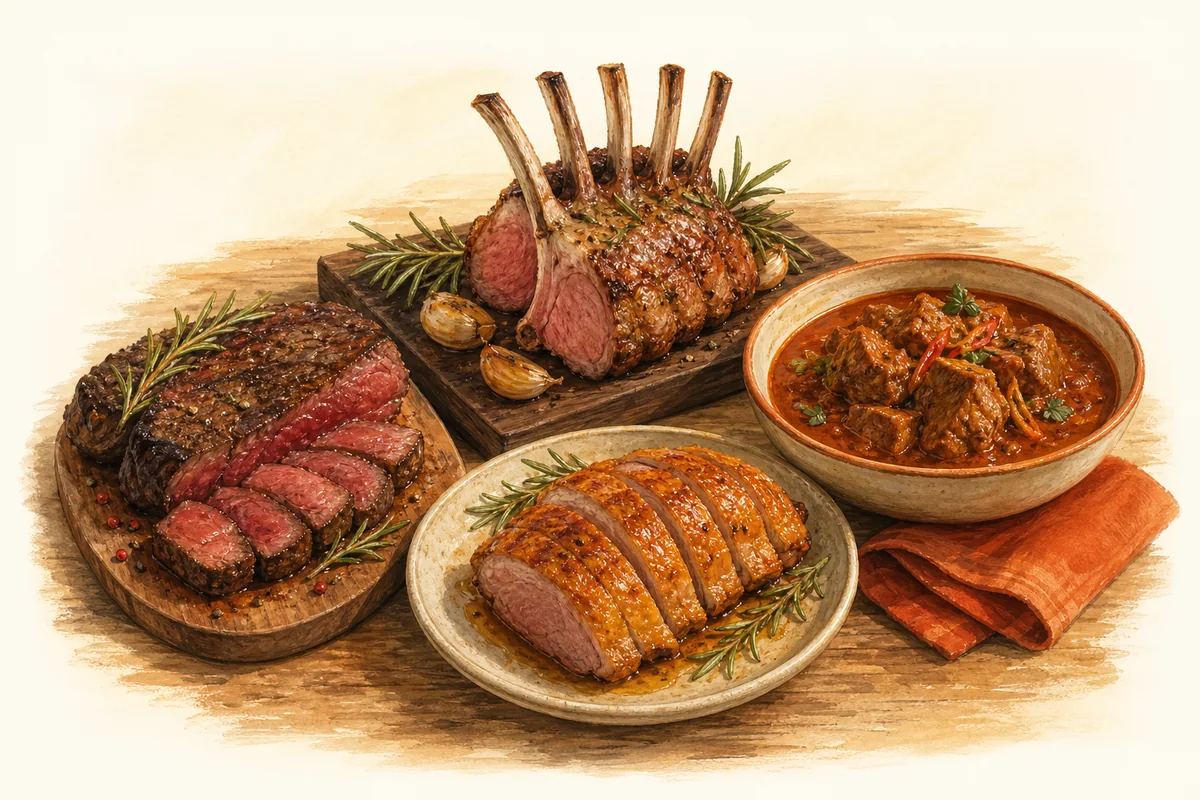
What does gamey mean?
Gamey (also spelled gamy) means tasting of game: the stronger, wilder flavour of animals such as deer, wild boar and game birds. Merriam-Webster dates the word to 1820 and records an older shade of meaning too: the flavour of game that has been kept until it is close to going off. That comes from a time when pheasant and venison were hung for days before cooking, until their flavour turned strong.
Today the word is used more loosely. It describes any meat with more character than the beef, chicken and pork most people eat every day, which is why lamb, goat and duck are called gamey too. Some diners mean it as praise, others as a warning.
What does gamey taste like?
People who try to put it into words usually reach for the same few descriptions:
- Earthy and musky: the most common one, strongest in older sheep and in goat.
- Iron-like or a little like liver: typical of lean, dark red meat such as venison.
- Rich and fatty: duck, whose flavour sits in the layer of fat under the skin.
- Grassy or farmy: meat from animals raised on pasture.
Gamey is as much a smell as a taste. Much of what people notice reaches them as aroma while the meat cooks and as they bite, which is also why a dish can smell stronger than it tastes.
Which meats taste gamey? A meat-by-meat guide
A rough guide, from mildest to strongest. Every animal varies with its age, its food and the cut, so treat it as a starting point.
| Meat | How gamey | What it tastes like | Where you meet it |
|---|---|---|---|
| Bison | Mild | Close to beef, a little sweeter and leaner | Bison burgers and steaks |
| Rabbit | Mild | Lean and pale, between chicken and pork; wild rabbit is stronger | Rabbit stew, paella valenciana |
| Duck | Mild to medium | Dark, rich meat with a fatty skin | Peking duck, duck breast, duck confit |
| Lamb | Mild to medium | Sweet and rich, slightly earthy; stronger in fatty cuts | Lamb chops, kofta, rogan josh |
| Venison | Medium | Lean, dark and iron-like, slightly sweet | Venison steak, stews in autumn and winter |
| Wild boar | Medium | Darker and deeper than pork | Wild boar ragù in Tuscany, sausages |
| Goat | Medium to strong | Lean and earthy, a little sweet | Goat curry, Jamaican curry goat, Mexican birria |
| Game birds | Medium to strong | Dark, rich, a little like liver | Pheasant, pigeon, grouse |
| Mutton | Strong | Deep and sheepy, above all in the fat | Mutton curry, slow-cooked stews |
What makes meat taste gamey?
Research on sheep, the animal studied most for this, points to three causes. They help explain the other meats too.
- The fat. Sheep and goat meat owe their typical flavour to tiny amounts of branched-chain fatty acids, such as 4-methyloctanoic acid. These are stored in the fat and partly set free when the meat is cooked (Lu, Young and Brooks, 2014). A German study of lamb chops found them in the fat, but at levels too low to measure in the lean muscle (Schiller and others, 2015). That is one reason fatty cuts tend to taste more strongly of lamb than lean ones.
- Age. The US Department of Agriculture says lamb has a milder flavour than mutton. Lamb comes from animals usually under a year old, most of them brought to market at six to eight months; mutton comes from older sheep.
- Diet. Animals raised on pasture can store skatole in their fat, a strong-smelling compound formed as they digest their feed. Grain-finished beef has almost none of it and almost none of the fatty acids above, which is one reason it tastes so neutral by comparison (Lu, Young and Brooks, 2014). It also explains why wild animals, which eat whatever they find, can taste stronger than farmed ones.
Why some people love gamey meat and others do not
Liking a gamey flavour is largely a matter of what you grew up with. The 2014 sausage study notes that the flavour of sheep meat is an acquired taste, generally not liked in many parts of the United States or in Japan, while people in New Zealand, where lamb is everyday food, are used to it. Familiarity does the work, as with other acquired tastes.
The smell seems to matter most. An Australian study measured these fatty acids in the fat of 178 lambs and had consumers score the grilled meat. The more of two of the acids the fat contained, the less people liked the smell; their liking of the flavour did not change (Watkins and others, 2014).
Garlic and rosemary: why they go with lamb
The classic pairing has a reason. In the 2014 study, 60 people tasted sausages with and without added sheep-flavour compounds. They liked the strongly flavoured ones less, but adding garlic and rosemary cancelled that difference out completely. Strong spices do the same in many cuisines: think of rogan josh, curry goat or birria, where the meat's own flavour meets a sauce strong enough to carry it.
How to order if you are not sure you like gamey meat
- Start with the mild ones. Bison, rabbit, duck breast and young lamb are the gentlest way in.
- Choose lamb over mutton. Younger animals taste milder.
- Pick leaner cuts. Leg or loin carries less of the flavour than shoulder, ribs or fatty mince.
- Go for a bold sauce or spice. Garlic, rosemary, curry spices and slow-cooked sauces soften the edge.
- Try a little first. A shared starter or a bite from someone else's plate costs less than a whole main course you do not enjoy.
If you want to know before you order, Taste10 can help: it learns your personal taste and predicts how much you will enjoy a dish such as lamb kofta or venison stew, with the reason why.
Gamey or not: will you enjoy it?
Some people order lamb for its strong flavour, others send it back. Taste10 learns your personal taste and predicts how much you will enjoy a dish before you order, with the reason why.
Taste10 is in testing. Want to try it early? Get in touch.
Questions and answers
What does gamey mean?
Gamey means tasting of game: a stronger, earthier and wilder flavour and smell than everyday meats such as beef, chicken and pork. It is used for venison, wild boar and game birds, and also for lamb, mutton, goat and duck.
Is gamey a good or bad thing?
Neither. For people who enjoy lamb or venison, a gamey flavour is the point. For people not used to it, it can be off-putting. Liking it is largely a matter of familiarity.
Is lamb gamey?
Lamb is mildly gamey. Its flavour comes mainly from its fat, so fatty cuts taste stronger than lean ones, and lamb is milder than mutton, which comes from older sheep.
Is bison gamey?
Bison is one of the mildest of these meats. It tastes close to beef, a little sweeter and leaner.
Which meat is the most gamey?
Mutton, goat and game birds such as pheasant and grouse are usually described as the strongest. Bison, rabbit, duck breast and young lamb are among the mildest.
Why does lamb taste gamey?
Sheep fat contains tiny amounts of branched-chain fatty acids that give lamb its typical flavour, and lambs raised on pasture can also store a strong-smelling compound called skatole in their fat. Both are released when the meat is cooked.
More about taste
- Acquired taste: meaning, examples and why tastes change
- What's on an Indian menu? 20 popular dishes from mild to hot, and what they taste like
- What's on a Chinese menu? 20 popular dishes and what they taste like
- How to stop being a picky eater as an adult
- What is mouthfeel? Meaning, food texture words and examples
Sources
- Merriam-Webster Dictionary: gamy. merriam-webster.com/dictionary/gamy
- US Department of Agriculture, Food Safety and Inspection Service: Lamb from farm to table. fsis.usda.gov
- Lu, Y., Young, O.A. and Brooks, J.D. Physicochemical and sensory characteristics of fermented sheepmeat sausage. Food Science & Nutrition, 2(6), 669-675 (2014). pmc.ncbi.nlm.nih.gov/articles/PMC4256571
- Watkins, P.J. et al. Effect of branched-chain fatty acids, 3-methylindole and 4-methylphenol on consumer sensory scores of grilled lamb meat. Meat Science, 96(2), 1088-1094 (2014). hdl.handle.net/1959.11/17689
- Schiller, K.F. et al. Concentration of three branched-chain fatty acids in adipose tissue does not affect meat sensory traits in crossbred and purebred German "Merinolandschaf" lambs. Archives Animal Breeding, 58, 159-163 (2015). doi.org/10.5194/aab-58-159-2015