
How to stop being a picky eater as an adult
Start from what you already love and move one small step at a time. Choose new foods that share something with your favourites, such as the same texture or the same main flavour, and taste them in small amounts more than once: liking often grows with every try.
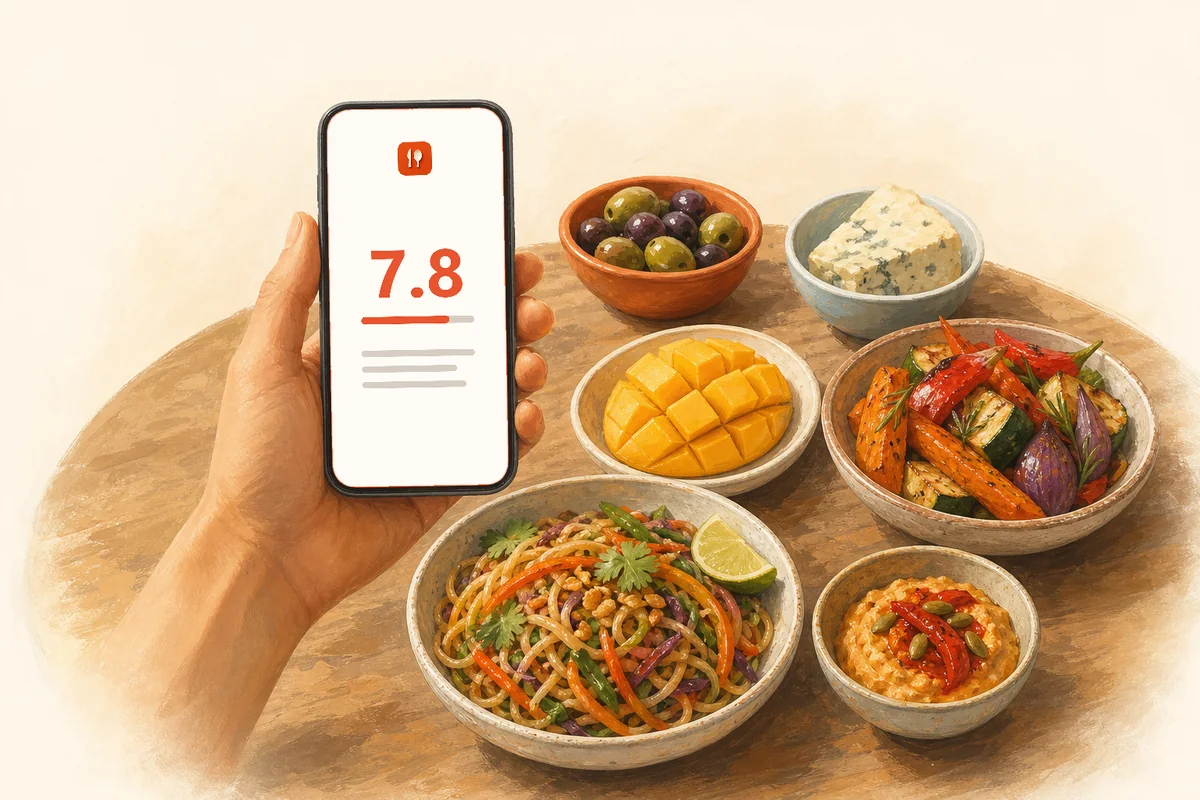
Why some adults eat a narrow range of foods
Reluctance to try new foods has a name: food neophobia. The psychologists Patricia Pliner and Karen Hobden built a scale to measure it in 1992 and found it was linked to anxiety and to how much experience someone already had with unusual foods. In other words, it is common, it is partly about uncertainty, and it can change with experience.
Taste also differs between people for reasons nobody chooses. Some people find coriander soapy because of a gene near their smell receptors, and sensitivity to some bitter tastes runs in families. A food you dislike may simply clash with your palate, which is why the goal is to find your next foods, not to force down everyone else's (see why the same food can be a 9 for you and a 3 for someone else).
8 steps to stop being a picky eater
- Start from your favourites. Write down five foods you love and what they have in common: crunchy, creamy, sweet, salty, mild, smoky.
- Take the next small step, not a leap. If you love roast chicken, try chicken satay before sea urchin. A new food that shares a texture or a flavour with something you like has a much better chance.
- Taste small amounts, more than once. In a review of 43 studies, Appleton and colleagues found that tasting a vegetable repeatedly made people like it more. One bite on one day is not a verdict.
- Change one thing at a time. A familiar dish with one new ingredient, or a new ingredient cooked a way you already like: roasted, fried or in a sauce you know.
- Check whether it is the texture. For many people the problem is not the taste but the feel: slimy, chewy, mushy. Try the same food prepared differently, such as mushrooms fried until crisp instead of stewed.
- Try new food when you are relaxed and hungry, not under pressure at a dinner party.
- Keep a record of what you tried and how it was. It shows progress and patterns you did not expect, such as liking sour more than you thought.
- Know before you order. For many people the biggest barrier is paying for a whole dish they end up not eating. A personal prediction takes most of that risk away.
Foods for picky eaters: next steps from what you love
| If you love | Try next | Why it may work |
|---|---|---|
| Chips (fries) | Roasted sweet potato, then vegetable tempura | Crisp outside, soft inside |
| Mild cheddar | Young Gouda, then Manchego | The same kind of cheese, a little stronger each time |
| Chicken nuggets | Chicken katsu, then Japanese karaage | A crunchy coating around mild chicken |
| Milk chocolate | Dark chocolate with 50% cocoa, then 70% | The sweetness goes down one step at a time |
| Tomato pasta | Shakshuka | A tomato sauce you know, with eggs instead of pasta |
| Plain rice | Egg fried rice, then coconut rice | The same base with one new flavour |
Where Taste10 fits
Taste10 makes steps 2, 7 and 8 easy. It learns your taste in a short setup and quick questions about foods. Then you photograph a menu, a product or a shelf and get a personal score from 0 to 10 with the reason why, before you order or buy. The score is a personal fit, not a quality rating, so a 7 means "worth a try for you". After you try something you rate it, and your taste portrait shows how your palate is changing.
Find your next favourite food
Taste10 learns your personal taste and shows you which new foods are the closest step from what you already love, as a score from 0 to 10 with the reason why, before you order.
Taste10 is in testing. Want to try it early? Get in touch.
Questions and answers
Can you stop being a picky eater as an adult?
Many adults widen the range of foods they enjoy with small steps and repeated tasting. How far you go is up to you: the aim is to enjoy more, not to eat everything.
How many times do I need to try a new food?
There is no fixed number. Studies on repeated tasting show that liking often grows over several tries, so do not judge a food on the first bite. If it still clashes after a few tries, it may simply not suit your palate.
What if picky eating is a real problem in my daily life?
This guide is about taste and curiosity. If eating is a strain in your daily life, talk to a doctor.
Can an app tell me which foods I will like?
Taste10 predicts how much you personally are likely to enjoy a food, drink or dish, with the reason why. It is a prediction, and your own ratings make it fit you better over time.
More about taste
- What is an acquired taste?
- How to know if you will like a food before you buy it
- How Taste10 learns your taste
Sources
- Pliner, P. and Hobden, K. (1992). Development of a scale to measure the trait of food neophobia in humans. Appetite, 19(2), 105–120. doi.org/10.1016/0195-6663(92)90014-W
- Appleton, K. M., Hemingway, A., Rajska, J. and Hartwell, H. (2018). Repeated exposure and conditioning strategies for increasing vegetable liking and intake: systematic review and meta-analyses of the published literature. American Journal of Clinical Nutrition, 108(4), 842–856. doi.org/10.1093/ajcn/nqy143
- Eriksson, N. and colleagues (2012). A genetic variant near olfactory receptor genes influences cilantro preference. Flavour, 1, 22. doi.org/10.1186/2044-7248-1-22