
What is mouthfeel? Meaning, food texture words and examples
Mouthfeel is the way a food or drink feels in your mouth: crispy or soft, creamy or chewy, smooth or grainy, slippery or dry. It is separate from taste (sweet, sour, salty, bitter, umami) and from smell. Texture is the largest part of it, and it is one of the main reasons people love or reject a food.
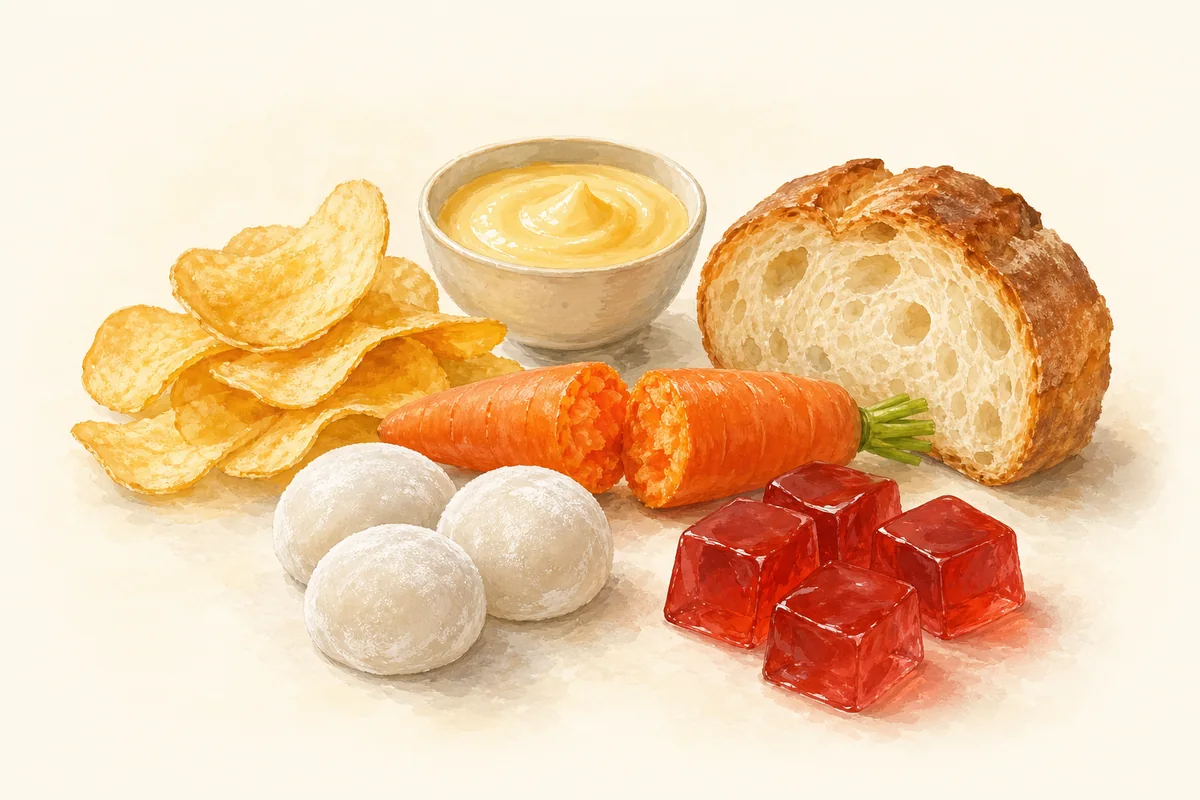
Mouthfeel, taste and texture: what is the difference?
Taste is what your tongue picks up (sweet, sour, salty, bitter and umami); mouthfeel is everything you feel. Merriam-Webster defines mouthfeel as the sensation created by food or drink in the mouth, and dates the word to 1951. Texture is the largest part of it: hard or soft, crunchy or chewy, smooth or grainy. Mouthfeel also covers sensations that are not strictly texture, such as the prickle of a fizzy drink or the dry pull of astringent black tea.
Two foods can taste almost the same and still feel completely different. A ripe and an overripe apple share their sweetness, but one is crisp and juicy and the other mealy. For many people, that difference decides whether they finish it.
Food texture words, with examples
These are the words people use most to describe how a food feels. Each comes with foods that show it clearly.
| Word | What it feels like | Examples |
|---|---|---|
| Crispy | Dry and brittle; snaps at once with a sharp, high sound | Potato crisps, thin crackers, fried shallots |
| Crunchy | Firm and dense; breaks in a series of cracks as you chew | Raw carrots, nuts, granola |
| Chewy | Springs back and needs many bites | Mochi, bagels, tapioca pearls, squid |
| Creamy | Thick, soft and smooth; spreads over the tongue | Custard, ripe avocado, sea urchin |
| Airy | Light, full of tiny bubbles, gives way easily | Mousse, meringue, the inside of fresh bread |
| Jelly-like | Soft and wobbly; slides and holds its shape | Fruit jelly, panna cotta, the white of a century egg |
| Slimy | Slippery and coating; may form strings | Okra, natto, raw oysters |
| Mealy | Soft but dry and grainy; falls into crumbs | An overripe apple, some cooked beans |
| Tender | Gives way easily under the teeth | Slow-cooked meat, ripe pear |
| Rich, coating | Leaves a film that lingers after swallowing | Butter, cream sauces, fatty fish |
| Fizzy | Prickles across the tongue | Sparkling water, cola, kombucha |
| Astringent | Dry and rough; the mouth wants to pucker | Strong black tea, unripe persimmon |
Crispy vs crunchy: is there a difference?
Crispy foods are dry and brittle and break all at once with a high-pitched sound; crunchy foods are denser and break in a series of cracks with a lower sound. That is the distinction proposed by a 2013 review of the research on the two words (see the sources). The review defines a crispy food as one that, bitten with the front teeth, breaks quickly and completely with a loud, high-pitched sound. A crunchy food is dense, chewed with the back teeth, and goes through a series of fractures with loud, low-pitched sounds.
The researchers admit the line is blurry. People, dictionaries and scientists use the words differently, and many studies treat them as nearly the same thing. A potato crisp is the classic crispy food; a raw carrot or a handful of nuts is crunchy.
Why texture decides whether you like a food
Researchers have long known that texture is a major reason people reject a food. A 2015 study (see the sources) went one step further: in an online survey of 500 people in the United States, it sorted them by how they like to eat, which the authors call mouth behaviour.
- Chewers (43%) like foods they can chew for a long time.
- Crunchers (33%) bite hard and like foods that break apart.
- Smooshers (16%) prefer soft foods that spread through the mouth, such as puddings.
- Suckers (8%) like hard foods they can keep in the mouth for a long time, such as hard sweets.
The authors conclude that what matters is not texture on its own, but whether a texture fits the way a person likes to eat. A cruncher and a smoosher may judge the same pudding very differently.
Foods whose texture surprises people
Some foods are famous less for their flavour than for how they feel. If you are trying one for the first time, the texture is usually what you notice first:
- Natto: fermented soybeans held together by sticky threads that stretch from the bowl to your chopsticks.
- Okra: soft pods that turn slippery when cut and cooked.
- Sea urchin: soft and creamy, melting on the tongue like custard.
- Century egg: a jelly-like white around a creamy yolk.
- Mochi: rice cakes that are soft, stretchy and very chewy.
- Tapioca pearls in bubble tea: chewy balls whose appeal is mostly the bite.
Texture is also often why a food is an acquired taste: the flavour may be fine, but the feel takes a few tries to get used to.
Kokumi: the fullness some foods have
Kokumi is a Japanese word for a sense of richness, thickness and lasting flavour that some foods give, beyond their basic taste. Japanese researchers scored it on three qualities: thickness, continuity and mouthfulness, the last meaning that the taste seems to fill the whole mouth. Substances that cause it, such as glutathione found in yeast extract, have almost no taste of their own but make salty, sweet and umami tastes stronger (see the 2010 study in the sources). It sits on the border between taste and mouthfeel.
How to describe mouthfeel
To put a food's mouthfeel into words, notice three moments:
- The first bite. Is it hard or soft, crisp or yielding? Does it make a sound?
- While you chew. Does it stay firm, turn creamy, get sticky or fall into crumbs? How long does it take?
- After you swallow. Does your mouth feel clean, coated, dry or fizzy?
The table above gives you the words. With practice, you will notice which of these moments you care about most. That is worth knowing, because the same texture can be someone's favourite and someone else's reason to push the plate away.
Which textures do you enjoy?
Some people love a crunch, others want everything soft and creamy. Taste10 learns your personal taste, including the textures you enjoy, and predicts how much you will like a food or drink before you try it, with the reason why.
Taste10 is in testing. Want to try it early? Get in touch.
Questions and answers
What does mouthfeel mean?
Mouthfeel is the sensation a food or drink creates in your mouth: how hard, soft, crunchy, chewy, creamy, slimy, fizzy or dry it feels. It is separate from taste and smell.
Is mouthfeel the same as texture?
Almost. Texture is the largest part of mouthfeel, but mouthfeel also includes sensations such as the prickle of fizzy drinks and the dry, rough feeling of strong tea.
What is the difference between crispy and crunchy?
Crispy foods are dry and brittle and snap at once with a high-pitched sound, like potato crisps. Crunchy foods are denser and break in several cracks with a lower sound as you chew, like raw carrots or nuts.
Why do some people dislike certain textures?
People differ in how they like to eat. A 2015 study sorted 500 people into chewers, crunchers, smooshers and suckers, and found that people like textures that fit their way of eating and reject those that do not.
What is kokumi?
Kokumi is a Japanese word for a sense of richness, thickness and lasting flavour. Substances that cause it have almost no taste themselves but make salty, sweet and umami tastes stronger.
More about taste
- What does "astringent" mean in food and drink?
- What is umami? The fifth taste explained
- What does natto taste like?
- Acquired taste: meaning, examples and why tastes change
Sources
- Merriam-Webster Dictionary: mouthfeel. merriam-webster.com/dictionary/mouthfeel
- Tunick, M.H. et al. Critical evaluation of crispy and crunchy textures: a review. International Journal of Food Properties, 16(5), 949-963 (2013). doi.org/10.1080/10942912.2011.573116
- Jeltema, M., Beckley, J. and Vahalik, J. Model for understanding consumer textural food choice. Food Science & Nutrition, 3(3), 202-212 (2015). pmc.ncbi.nlm.nih.gov/articles/PMC4431788
- Ohsu, T. et al. Involvement of the calcium-sensing receptor in human taste perception. Journal of Biological Chemistry, 285(2), 1016-1022 (2010). pmc.ncbi.nlm.nih.gov/articles/PMC2801228