
What does sea urchin taste like?
Sea urchin, called uni in Japan, tastes sweet, briny and rich, like a mix of fresh oyster, butter and the sea itself. It is soft and creamy and melts on the tongue like custard. Fresh uni is sweet with a long savoury finish; older or poorly kept uni can taste bitter or metallic, which is why opinions about it differ so much.
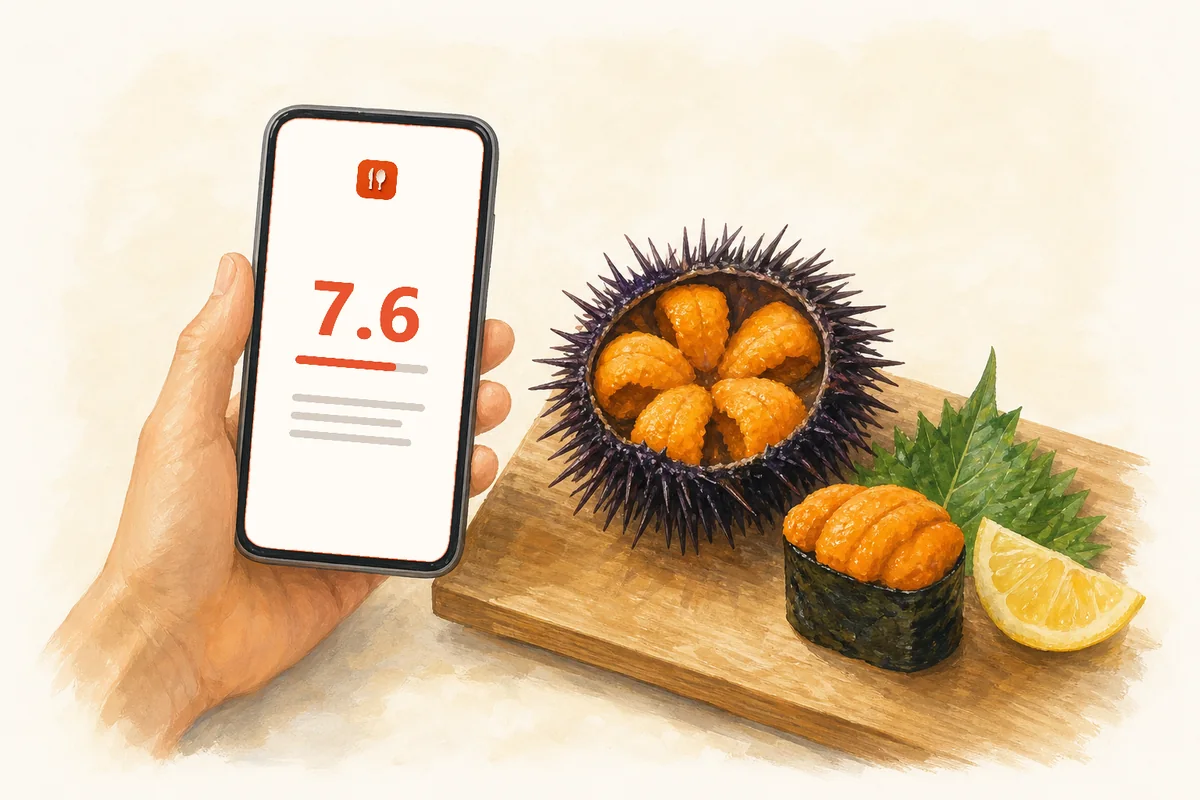
The taste of sea urchin, in short
| Quality | What to expect |
|---|---|
| Sweetness | Noticeable and gentle, stronger in very fresh uni |
| Sea taste | Clearly briny, like a breath of sea air or a fresh oyster |
| Savoury depth | High, a rich umami that lingers |
| Bitterness | None to slight when fresh; stronger in older or tray-packed uni |
| Texture | Soft and creamy, melting on the tongue like custard |
What uni is
Uni is the Japanese name for the edible part of the sea urchin, a round, spiny animal that lives on rocky sea floors. What you eat are its gonads, the reproductive organs: five tongue-shaped lobes inside the shell, coloured from pale yellow to deep orange. They are usually eaten raw. In Japan you meet uni most often as sushi, wrapped in a band of seaweed, or piled on a bowl of rice (uni-don). Italy tosses it through spaghetti, France serves it raw from the shell as oursins, and Chile eats it as erizos.
Why uni tastes sweet, salty and a little bitter at once
A Japanese food scientist, Yasushi Komata, rebuilt the taste of raw uni in the laboratory in 1964 by mixing its natural compounds and leaving them out one at a time. He found that the taste comes mainly from a handful of amino acids:
- Glycine and alanine give the sweetness.
- Glutamic acid, together with natural flavour boosters from the same family as those in dashi, gives the savoury, meaty depth.
- Valine and methionine add a faint bitter note. Methionine is only present in tiny amounts, yet without it the mix did not taste like uni at all.
That balance is why good uni tastes rich and sweet with a long, briny finish, and why the bitter side takes over when the balance shifts.
Why one piece of uni tastes great and the next does not
Few foods vary as much from one serving to the next. Three things make most of the difference:
- Freshness. Uni starts to change within days. Fresh lobes are firm, glossy and sweet; older ones turn soft, watery and more bitter or metallic.
- How it is packed. Uni sold in wooden trays is often treated with alum to keep the lobes from collapsing. A Japanese study found that alum does this job but brings out bitterness at higher strengths. Uni kept in salt water (ensui uni) or opened in front of you usually tastes cleaner.
- What the urchin ate. Urchins that graze on kelp tend to have sweeter, better-coloured uni. Researchers have found that feed very high in protein makes the taste less sweet and more bitter.
So if your first uni was disappointing, it may have been the uni rather than your taste.
You may enjoy uni if you like
- oysters, scallops or other raw seafood with a clean sea taste;
- rich, soft things such as egg yolk, custard or good butter;
- deeply savoury flavours, such as miso, parmesan or dashi.
If raw seafood or soft, slippery textures put you off, uni is likely to be a miss, however fresh it is.
Trying sea urchin for the first time
- Choose a good place. A busy sushi counter, or a seafood market where the urchin is opened in front of you, gives you the best chance of fresh uni.
- Look before you eat. Lobes that hold their shape, glossy and bright, are a good sign; grey, runny or dull ones are not.
- Start with sushi or pasta. Rice and pasta soften the strong sea taste; uni on its own from the shell is the most intense.
- Go easy on soy sauce. A touch is enough, or none: it can hide the sweetness that makes uni special.
Will you like it? Ask about your own taste
Uni is expensive, and an average rating tells you little about whether you will enjoy it. Taste10 learns your personal taste and predicts how much you will enjoy a food before you try it, with the reason why. Photograph a sushi menu or a market stall and see your own score before you order.
Taste10 is in testing. Want to try it early? Get in touch.
Questions and answers
What part of the sea urchin do you eat?
The gonads: five orange or yellow lobes inside the spiny shell. They are usually eaten raw, as sushi, on rice or straight from the shell.
Does sea urchin taste fishy?
Fresh uni does not. It tastes of the sea in a clean, sweet way, closer to an oyster than to fish. A fishy, bitter or metallic taste usually means it is no longer fresh.
Why is some uni bitter?
Mostly because of age or the way it was packed. Uni in wooden trays is often treated with alum to keep its shape, which can add bitterness. What the urchin ate plays a part too.
What does uni taste similar to?
People compare it to a mix of oyster, egg yolk and butter, or to a savoury custard that tastes of the sea. Nothing matches it exactly.
More about taste
- What does natto taste like?
- 12 Japanese convenience store foods, and what they taste like
- What is umami? The fifth taste explained
- What is an acquired taste?
Sources
- Komata, Y. (1964). Studies on the extract components of sea urchin (Uni), IV: taste of each component of the extract (in Japanese, English summary). Nippon Suisan Gakkaishi, 30(9), 749–756. doi.org/10.2331/suisan.30.749
- Takagi, S., Murata, Y., Koshiishi, T. and Agatsuma, Y. (2020). The amino acids glutamic acid and alanine in feed increase the alanine content in gonads of the sea urchin Mesocentrotus nudus. Frontiers in Marine Science, 7, 593. doi.org/10.3389/fmars.2020.00593
- Yamaishi, H., Watanabe, T. and Fujita, D. (2008). A possibility of improving Strongylocentrotus intermedius gonad conditions by dipping into deep seawater as a substitute for alum solution. Deep Ocean Water Research, 9(2), 79–81. doi.org/10.11174/dowas2000.9.2_79