
How to find food you like after moving abroad
Do not try to replace everything from home at once. Pick the few foods you miss most and look for their closest local versions, learn the local staples one at a time, and check unfamiliar products before you buy them, so your weekly shop stops being a gamble.
Why food is one of the hardest parts of moving
In a 2025 study of international students in Norway, missing the taste of home was one of five main themes, next to food prices, language barriers and simply not knowing what a product is. The study's title quotes one of them: "I bought it, but I still don't know what it is." People who move for work describe the same thing: the weekly shop takes twice as long, and part of it ends up in the bin.
7 steps to eating well in a new country
- List what you miss, and why. Not "bread from home" but what about it: the dense crumb, the sour taste, the crust.
- Find the local cousin. Most foods have a close relative in another country (see the table below).
- Learn one local staple a week: the bread, the cheese, the breakfast. Try two or three versions side by side.
- Ask locals what they buy: colleagues and neighbours know the brands worth trying.
- Keep the international shops for the foods nothing replaces. They cost more, so use them for comfort, not for everything.
- Keep a list of hits and misses, with a photo of each pack you liked. Six months later it is your own local shopping list.
- Check before you buy, especially when you cannot read the label.
Missing this? Look for its local cousin
| If you miss | Look for | Often found |
|---|---|---|
| Quark | Skyr, fromage frais, strained yoghurt | Dairy aisle |
| Sour cream | Crème fraîche, smetana, thick Greek yoghurt | Dairy aisle |
| Mature cheddar | Aged Gouda, Comté, Manchego | Cheese counter |
| Dark rye bread | Wholegrain sourdough, Scandinavian crispbread | Bakery or bread aisle |
| Your instant noodles | The same brand, or its neighbours | Asian supermarket |
Where Taste10 fits
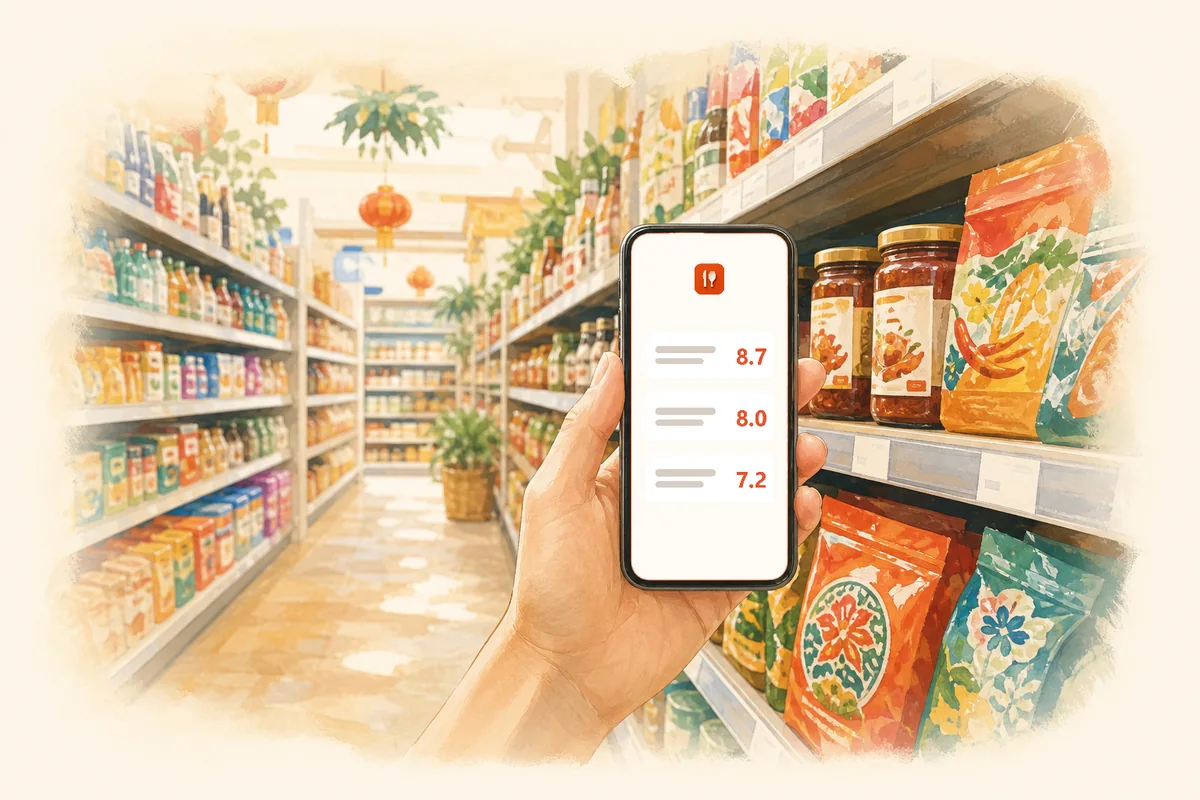
Photograph a product, or a whole shelf, and Taste10 tells you in your language what it is, what it tastes like and how well it fits your taste, before you pay. Rate what you tried, and it gets to know you better with every shop. Over the first weeks your saved scans become the list of local products you actually like. More about choosing in a foreign supermarket.
Feel at home in a new supermarket
Taste10 tells you what an unfamiliar product is and how well it fits your personal taste, with the reason why, in your language, so you buy what you will actually enjoy.
Taste10 is in testing. Want to try it early? Get in touch.
Questions and answers
How long does it take to get used to food in a new country?
It differs from person to person. Learning one local staple at a time, and keeping a few comforts from home, makes the change easier.
Where can I find food from home abroad?
In the international aisle of large supermarkets, in shops for a particular cuisine, and from online shops that deliver food from your home country.
Can Taste10 read labels in the local language?
Yes. It reads labels in many languages and scripts and tells you in your app language what the product is and how well it fits you.
Does Taste10 work with local brands?
Yes. It works with any product you can photograph, including brands it has never seen before.
More about taste
- 12 unusual Asian supermarket finds, and what they taste like
- How to know if you will like a food before you buy it
- Choosing in a foreign supermarket
Sources
- Medin, A. C., Polspoel, M. E. M., Vejrup, K., Strömmer, S. T., Barker, M. E. and Øverby, N. C. (2025). "I bought it, but I still don't know what it is": international students dealing with a new food culture in Norway. A qualitative study. International Journal of Qualitative Studies on Health and Well-being, 20(1). doi.org/10.1080/17482631.2025.2595849