
What's on a Vietnamese menu? 20 popular dishes and what they taste like
Vietnamese food is built on rice noodles, rice, fresh herbs and fish sauce, and most of it is not spicy: the chilli usually waits on the table for you to add. Pho, fresh spring rolls, banh mi, bun cha and broken rice are mild, fresh and savoury; bun bo Hue is the hot one. Here are 20 popular Vietnamese dishes, what they taste like, and the menu words that help you guess the rest. With the menu in front of you, Taste10 ranks its dishes for your personal taste.
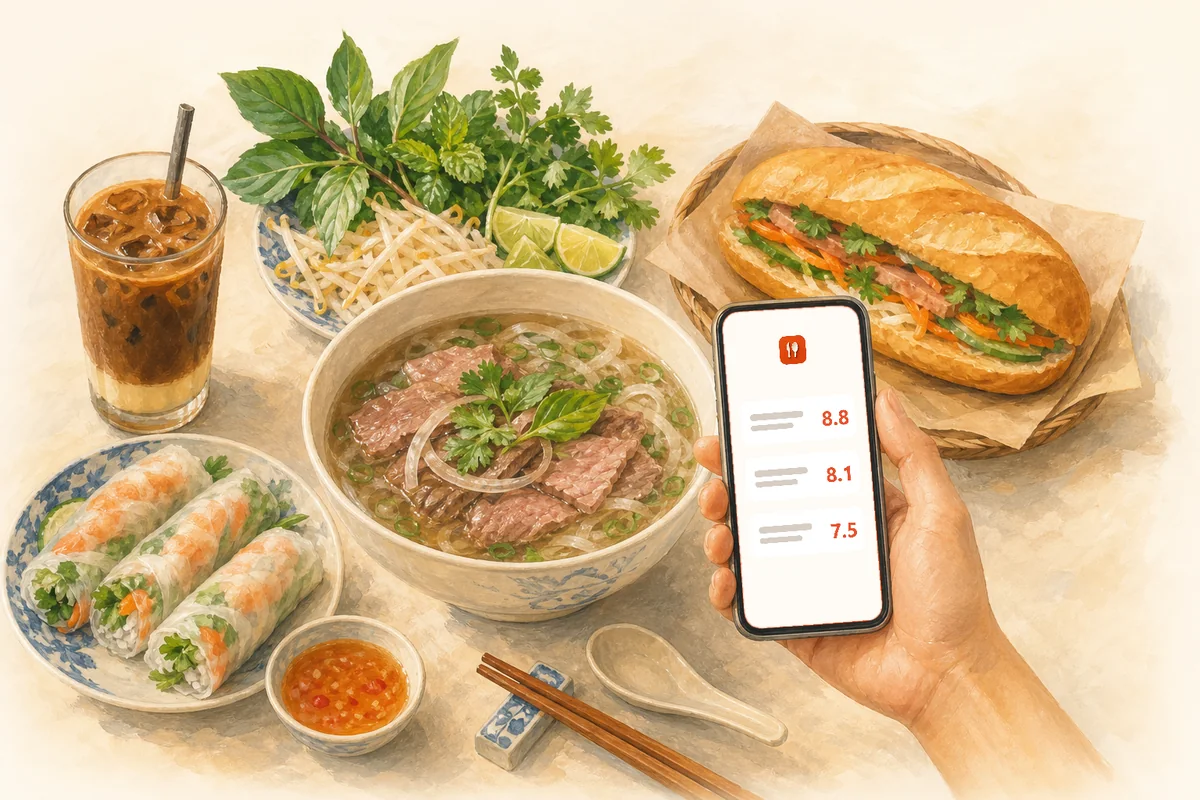
Vietnamese restaurants abroad serve dishes from three regions. The north, around Hanoi, cooks mild, clear dishes such as pho and bun cha. Central Vietnam, around Hue and Hoi An, is known for its dipping sauces, and Hue for its chilli. The south, around Ho Chi Minh City, likes sweetness and big plates of fresh herbs. Almost everything meets fish sauce somewhere, and noodle dishes come with a plate of herbs to add yourself. The order below goes from rolls and pancakes through the noodle soups and noodle bowls to rice and beef, banh mi, dessert and three coffees.
Rolls and pancakes
1. Goi cuon (fresh spring rolls)
Also sold as summer rolls or salad rolls. Soft, see-through rice paper wrapped around lettuce, mint, coriander, rice noodles and usually pork and prawns. Served cold with a peanut-hoisin dip or nước chấm. Cool, fresh and herby, with a soft, slightly chewy skin; the dip brings the flavour.
2. Cha gio or nem ran (fried spring rolls)
Called chả giò in the south and nem rán in the north: minced pork, mushrooms, vermicelli and vegetables rolled in rice paper and deep-fried. Eaten wrapped in lettuce and herbs and dipped in fish sauce thinned with vinegar and water. Very crisp and golden outside, savoury and peppery inside; the lettuce and herbs freshen each bite.
3. Banh xeo (sizzling pancake)
A thin pancake of rice flour and coconut milk, coloured yellow with turmeric, filled with pork, prawns and bean sprouts and folded like a crepe. Xèo means sizzling, the sound the batter makes in the pan. Break off a piece, wrap it in lettuce and herbs, and dip it. Crisp, lacy edges, a rich coconut note and a savoury filling; best eaten hot.
4. Bo la lot (beef in betel leaves)
Seasoned minced beef with garlic and shallots, rolled in wild betel leaves like small cigars and grilled over charcoal. Served with noodles or rolled in rice paper with herbs. Smoky, meaty and peppery, with a leafy, slightly charred wrapper.
Noodle soups
5. Pho bo (beef pho)
Vietnam's national dish: flat rice noodles in a beef broth simmered for hours with star anise, cinnamon, cloves and cardamom, topped with beef. The menu tells you which beef: tái is medium rare, chín well done, nạm flank, gầu brisket, gân tendon and sách tripe; tái chín, a mix, is the usual order. In Vietnam it is a breakfast dish. A clear, savoury broth with a warm, sweet spice scent; light rather than heavy.
6. Pho ga (chicken pho)
The same rice noodles in a chicken broth with sliced chicken, spring onion and herbs. Chicken pho appeared in 1939, possibly because beef was not sold at the markets on some days of the week. Lighter and cleaner than beef pho, gently savoury: one of the mildest dishes on the menu.
7. Bun bo Hue (spicy beef noodle soup from Hue)
From Hue, the old imperial capital in central Vietnam. Round rice noodles in a red broth of beef and pork bones with lemongrass and shrimp paste, topped with beef shank and often pork sausage, pork hock or cubes of pork blood. Hot, rich and citrusy from the lemongrass, with a deep, funky savouriness from the shrimp paste.
8. Bun rieu (crab and tomato noodle soup)
Rice vermicelli in a broth made from crushed crab, with soft clusters of crab, pork and egg, tofu and stewed tomatoes. Clearly sour from the tomato, with a sweet, briny crab flavour and soft, pillowy toppings.
9. Mi Quang (Quang noodles)
From Quang Nam province in central Vietnam: flat yellow turmeric noodles in only a ladleful of rich broth, topped with pork, prawns or chicken, peanuts, herbs and a sesame rice cracker. Part soup, part salad. Savoury and nutty, with crunch from the cracker and peanuts and little liquid.
10. Cao lau (Hoi An noodles)
Found properly only in Hoi An: thick, chewy noodles with slices of barbecued pork, a little spiced broth, fresh herbs and crushed pork crackling. The dish mixes Japanese, Chinese and Vietnamese influences. Chewy and savoury, a little sweet from the pork, with fresh herbs and crunchy crackling.
Noodles without soup
11. Bun cha (grilled pork with noodles)
A Hanoi lunch: grilled pork patties and slices of pork belly in a bowl of fish-sauce broth, served with cold rice vermicelli and a plate of herbs and greens. Dip the noodles into the broth and rotate between noodles, pork and greens. Smoky, sweet and savoury pork in a tangy dip, balanced by cool noodles and herbs.
12. Bun thit nuong (grilled pork noodle bowl)
Cold rice vermicelli with hot grilled pork, herbs, lettuce, roasted peanuts and a fish-sauce dressing, often with a fried spring roll on top. Usually listed among the vermicelli bowls. Hot and cold, smoky and fresh at once, sweet and tangy from the dressing.
13. Banh cuon (steamed rice rolls)
Thin sheets of steamed rice batter rolled around minced pork and wood ear mushroom, topped with fried shallots and served with a sweet and sour fish sauce and slices of pork sausage. A breakfast in the north. Silky, soft and delicate, with a savoury filling and a sweet-sour dip.
Rice and beef
14. Com tam (broken rice)
Rice from fractured grains, once eaten by farmers who could not sell them and now a southern favourite. The classic plate has a caramelised grilled pork chop and often a fried egg, with pickled carrot and daikon, cucumber and sweetened fish sauce. Sweet, smoky pork on soft rice, freshened by the pickles.
15. Bo luc lac (shaking beef)
Cubes of beef marinated in fish sauce, soy sauce and oyster sauce, seared in a wok with red onion and pepper, and served on lettuce or watercress with tomato and cucumber. The name means shaking beef, after the shaking of the wok or the cubes that look like dice. Popular in the United States. Seared and juicy, savoury and slightly sweet, lifted by the cool salad.
Bread
16. Banh mi
A baguette from the French colonial years made Vietnamese: pâté and margarine spread inside, then pork, pickled carrot and daikon, cucumber and fresh coriander. Many versions exist, from grilled beef to fried egg. Crackly crust and soft inside, rich and savoury meat against sharp pickles and fresh herbs.
Dessert and coffee
17. Che (sweet soups and puddings)
A family of desserts served hot or cold, made from beans, jellies, tapioca, fruit and coconut cream, often with crushed ice. Chè ba màu, the three-colour one, layers red beans, mung beans and pandan jelly. Sweet, creamy and full of textures: soft beans, chewy jellies and ice.
18. Ca phe sua da (Vietnamese iced coffee)
The everyday coffee of the south. Strong dark-roast robusta is dripped through a small metal filter, the phin, onto sweetened condensed milk, then stirred and poured over ice. Strong and bitter coffee made very sweet and creamy by the condensed milk.
19. Ca phe trung (egg coffee)
Created in Hanoi in the late 1940s at Café Giảng, when milk was scarce: egg yolks whipped with sugar into a thick, warm foam that sits on top of strong coffee. Often served in a small bowl of hot water to keep it warm. Sip the coffee through the foam. Like a warm, liquid tiramisu: sweet, velvety foam over bitter coffee.
20. Ca phe muoi (salt coffee)
From Hue in central Vietnam: robusta drip coffee topped with a layer of lightly salted cream and condensed milk, which slowly melts into the coffee below. Salty, sweet, bitter and creamy at once; the salt softens the bitterness and brings out a salted-caramel note.
Is Vietnamese food spicy?
Mostly not. Vietnamese cooking puts the heat on the table rather than in the pot: fresh chilli, chilli sauce, garlic and chilli in vinegar, and lime, for each person to add. The clear exception is bun bo Hue, and the food of Hue in general, which is famous for chilli oil and chilli jam. For how chilli heat is measured, see the Scoville scale. Kitchens differ, so take this as a rough guide.
| Heat | Dishes | What to expect |
|---|---|---|
| None | fresh spring rolls, fried spring rolls, banh xeo, pho, bun rieu, cao lau, bun cha, bun thit nuong, banh cuon, com tam, shaking beef, banh mi, che, the coffees | savoury, sweet, sour or herby; add chilli yourself |
| Gentle | bo la lot | peppery rather than hot |
| Some | mi Quang | a little chilli on top |
| Hot | bun bo Hue | chilli in the broth itself |
How to eat pho
Pho arrives with a plate of extras, more of them in the south: bean sprouts, Thai basil, coriander or culantro, lime wedges and sliced chilli, with hoisin and sriracha on the table. Vietnamese guides suggest tasting the broth on its own first. Then add a little at a time: lime makes it brighter, herbs fresher, chilli hotter, and hoisin sweeter and darker. In Hanoi, pho is often served with almost nothing to add, because the broth is the point.
Menu words that tell you what is in a dish
Vietnamese dish names are built from a few words: what the starch is, how it is cooked and what goes with it. Menus abroad often drop the accents, so "bún" may appear as "bun". A handful of words is enough to read most menus.
| Word on the menu | What it means | Example |
|---|---|---|
| phở / pho | flat rice noodles | pho bo |
| bún / bun | round rice vermicelli | bun cha |
| cơm / com | rice | com tam |
| bánh / banh | bread, pancakes, rice rolls and cakes | banh mi, banh xeo |
| cuốn / cuon | rolled | goi cuon |
| gỏi / goi | salad | goi cuon |
| chả / cha | patties, cakes or sausage of minced meat or fish | bun cha |
| nướng / nuong | grilled | bun thit nuong |
| xào / xao | stir-fried | mien xao (stir-fried glass noodles) |
| bò / bo | beef | pho bo |
| gà / ga | chicken | pho ga |
| thịt / thit | meat, usually pork | bun thit nuong |
| tôm / tom; cá / ca | prawns; fish | cha ca (fish cakes) |
| tái / tai | medium rare beef in pho | pho tai |
| cà phê / ca phe | coffee; sữa is milk, đá ice, trứng egg, muối salt | ca phe sua da |
Sauces you will meet
- Nước mắm (fish sauce): made by fermenting fish with salt for months. Salty, briny and deeply savoury, sometimes with a touch of sweetness or caramel. Vietnamese cooks use it where Chinese cooks would use soy sauce.
- Nước chấm: the everyday dip, fish sauce mixed with sugar, lime or vinegar, garlic and chilli. Sweet, sour, salty and a little hot.
- Peanut sauce: thick, nutty and sweet, often based on hoisin, served with fresh spring rolls.
- Hoisin and sriracha: on the table at pho restaurants, sweet and dark, and hot and garlicky.
- Shrimp paste: fermented and pungent, used in bun bo Hue and many central dishes. Strong on its own, deep and savoury once cooked in.
What to order at a Vietnamese restaurant
A Vietnamese meal for two is easy to build: one roll to share, one soup or noodle bowl each, and one rice dish or shaking beef in the middle. For a first visit, try fresh spring rolls, pho bo and bun cha, with a Vietnamese iced coffee. If you like it hot, order bun bo Hue; if you prefer sweet and savoury, com tam or shaking beef. After the meal, try an egg or salt coffee. Sauces and herbs change a dish a lot, so taste first and add at the table.
All 20 at a glance
| Dish | Taste |
|---|---|
| Goi cuon (fresh spring rolls) | Cool, fresh and herby, with a soft, slightly chewy skin; the dip brings the flavour |
| Cha gio or nem ran (fried spring rolls) | Very crisp and golden outside, savoury and peppery inside; the lettuce and herbs freshen each bite |
| Banh xeo (sizzling pancake) | Crisp, lacy edges, a rich coconut note and a savoury filling; best eaten hot |
| Bo la lot (beef in betel leaves) | Smoky, meaty and peppery, with a leafy, slightly charred wrapper |
| Pho bo (beef pho) | A clear, savoury broth with a warm, sweet spice scent; light rather than heavy |
| Pho ga (chicken pho) | Lighter and cleaner than beef pho, gently savoury: one of the mildest dishes on the menu |
| Bun bo Hue (spicy beef noodle soup from Hue) | Hot, rich and citrusy from the lemongrass, with a deep, funky savouriness from the shrimp paste |
| Bun rieu (crab and tomato noodle soup) | Clearly sour from the tomato, with a sweet, briny crab flavour and soft, pillowy toppings |
| Mi Quang (Quang noodles) | Savoury and nutty, with crunch from the cracker and peanuts and little liquid |
| Cao lau (Hoi An noodles) | Chewy and savoury, a little sweet from the pork, with fresh herbs and crunchy crackling |
| Bun cha (grilled pork with noodles) | Smoky, sweet and savoury pork in a tangy dip, balanced by cool noodles and herbs |
| Bun thit nuong (grilled pork noodle bowl) | Hot and cold, smoky and fresh at once, sweet and tangy from the dressing |
| Banh cuon (steamed rice rolls) | Silky, soft and delicate, with a savoury filling and a sweet-sour dip |
| Com tam (broken rice) | Sweet, smoky pork on soft rice, freshened by the pickles |
| Bo luc lac (shaking beef) | Seared and juicy, savoury and slightly sweet, lifted by the cool salad |
| Banh mi | Crackly crust and soft inside, rich and savoury meat against sharp pickles and fresh herbs |
| Che (sweet soups and puddings) | Sweet, creamy and full of textures: soft beans, chewy jellies and ice |
| Ca phe sua da (Vietnamese iced coffee) | Strong and bitter coffee made very sweet and creamy by the condensed milk |
| Ca phe trung (egg coffee) | Like a warm, liquid tiramisu: sweet, velvety foam over bitter coffee |
| Ca phe muoi (salt coffee) | Salty, sweet, bitter and creamy at once; the salt softens the bitterness and brings out a salted-caramel note |
Which of these would you like most?
A guide tells you what each dish tastes like. Taste10 learns your personal taste and predicts which of these you will enjoy most. Photograph a Vietnamese menu, or take a screenshot of a delivery app's menu, and see the dishes ranked for you, with the reason why.
Taste10 is in testing. Want to try it early? Get in touch.
Questions and answers
What is the difference between pho and ramen?
Pho is Vietnamese: flat rice noodles in a clear beef or chicken broth scented with star anise, cinnamon and cloves, with herbs and lime added at the table. Ramen is Japanese, of Chinese origin: springy wheat noodles made with alkaline water, in a broth often seasoned with soy sauce or miso, topped with pork, egg and seaweed. Pho tastes lighter and more aromatic; ramen is usually richer and saltier.
Is Vietnamese food spicy?
Mostly not. The chilli is usually served on the side, fresh or as a sauce, for each person to add. The best-known hot dish is bun bo Hue, a spicy beef noodle soup from Hue in central Vietnam.
What is the difference between fresh spring rolls and fried spring rolls?
Fresh spring rolls (goi cuon, also called summer rolls) are soft rice paper wrapped around herbs, noodles, pork and prawns and served cold. Fried spring rolls (cha gio or nem ran) are filled with minced pork and vegetables and deep-fried until crisp.
What is nuoc cham?
Nuoc cham is the everyday Vietnamese dipping sauce: fish sauce mixed with sugar, lime or vinegar, garlic and chilli. It tastes sweet, sour, salty and a little hot, and goes with rolls, grilled meat and noodle bowls.
What does Vietnamese egg coffee taste like?
Egg coffee (ca phe trung) tastes like a warm, liquid tiramisu: a thick, sweet foam of whipped egg yolk and sugar over strong, bitter Vietnamese coffee. It was created in Hanoi in the late 1940s, when milk was scarce. Salt coffee (ca phe muoi) from Hue is the other famous variation, with a salted cream that tastes of salted caramel.
What should I order at a Vietnamese restaurant for the first time?
Fresh spring rolls to share, then pho bo or bun cha, are a safe and typical start; add a Vietnamese iced coffee, or an egg coffee after the meal. If you like heat, try bun bo Hue; if you like sweet and savoury, com tam with grilled pork.
More about taste
- 15 popular Thai dishes explained, before you order
- What's on a Chinese menu? 20 popular dishes and what they taste like
- Why does coriander taste like soap to some people?
- Coffee drinks explained: how to pick one you'll enjoy
- Everyone is ordering dishes to share and I get one pick
- I'm at a night market with 30 stalls and room for three dishes
Sources
- Viet Nam National Authority of Tourism: 21 must-try Vietnamese dishes. vietnam.travel
- Viet Nam National Authority of Tourism: Must-try noodles in Vietnam. vietnam.travel
- Viet Nam National Authority of Tourism: A foodie guide to Vietnam by region. vietnam.travel
- Viet Nam National Authority of Tourism: 10 delicious Vietnamese rolls. vietnam.travel
- Viet Nam National Authority of Tourism: Fish sauce (nước mắm). vietnam.travel
- Viet Nam National Authority of Tourism: Bánh mì in Vietnam. vietnam.travel
- Viet Nam National Authority of Tourism: A beginner's guide to Vietnamese street food. vietnam.travel
- Viet Nam National Authority of Tourism: Hue's best to eat, from the palace to the street. vietnam.travel
- Viet Nam National Authority of Tourism: A taste of Vietnam, the story behind its beloved coffee culture. vietnam.travel
- Viet Nam National Authority of Tourism: 10 must-try Hanoian dishes (cà phê trứng). vietnam.travel
- Egg coffee. Wikipedia. en.wikipedia.org/wiki/Egg_coffee
- Viet Nam National Authority of Tourism: Seven delightful Vietnamese drinks. vietnam.travel
- Encyclopaedia Britannica: pho. britannica.com/topic/pho
- Encyclopaedia Britannica: fish sauce. britannica.com/topic/fish-sauce
- Encyclopaedia Britannica: ramen. britannica.com/topic/ramen
- Pho. Wikipedia (the beef cuts on a pho menu; chicken pho from 1939). en.wikipedia.org/wiki/Pho
- Chả giò. Wikipedia. en.wikipedia.org
- Shaking beef. Wikipedia. en.wikipedia.org/wiki/Shaking_beef
- Vietnamese iced coffee. Wikipedia. en.wikipedia.org
- Chè. Wikipedia. en.wikipedia.org