
What does salty liquorice taste like?
Salty liquorice, or salmiak, tastes sweet, salty and sharp at the same time, with the aniseed and caramel notes of ordinary black liquorice underneath. The salt is not table salt but ammonium chloride, which tastes saltier, sharper and a little bitter, and leaves a tingle on the tongue. Sweet liquorice is soft and mild; salty liquorice ranges from gently salty to strong enough to make your eyes water.
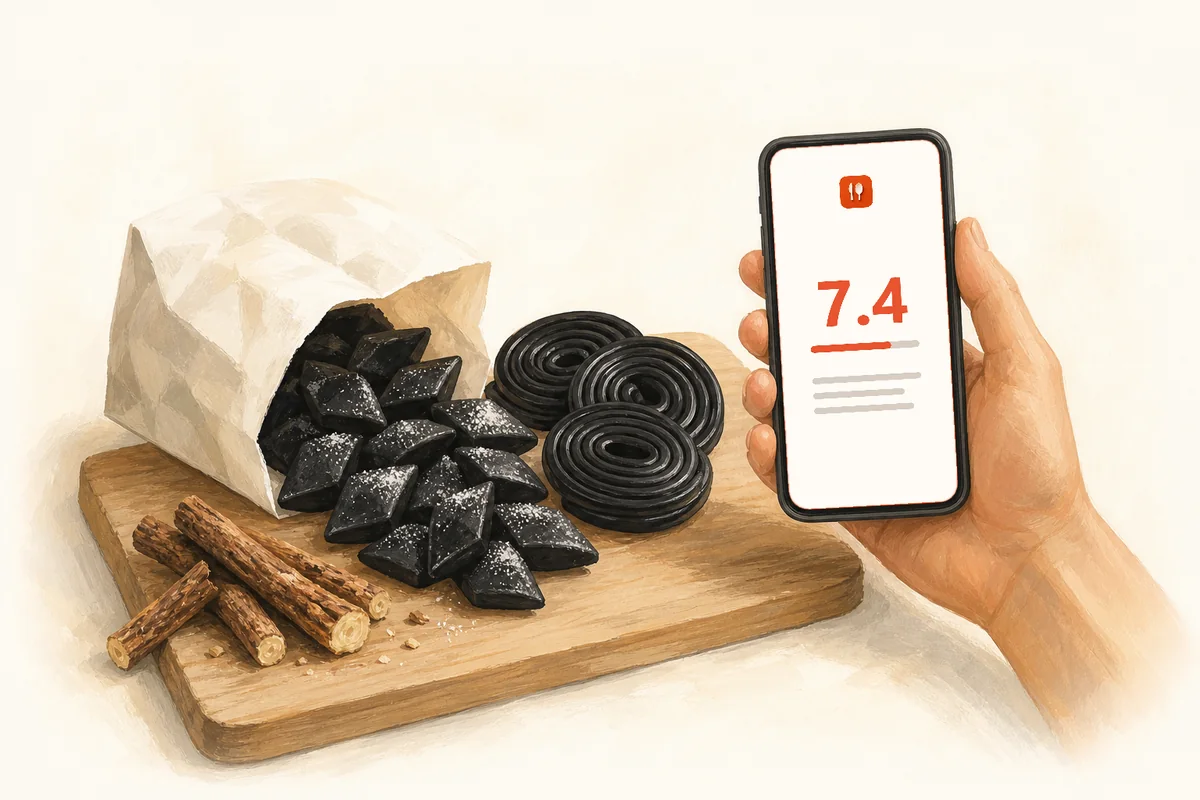
Salty and sweet liquorice side by side
| Sweet liquorice | Salty liquorice (salmiak) | |
|---|---|---|
| Sweetness | High, slow to build and long to fade | Medium, under the salt |
| Salt | None to a little | Strong, sharp, sometimes almost stinging |
| Bitterness | Gentle, in the background | Clear, especially in "double salt" kinds |
| Aroma | Aniseed, caramel, a little herbal | The same, with a sharp, almost peppery edge |
| Feel on the tongue | Soft and chewy | A tingle, sometimes a cooling or numbing feeling |
| Where it is loved most | Most of Europe, the UK, Australia | Finland, Sweden, Norway, Denmark, the Netherlands, northern Germany |
What liquorice is made of
Black liquorice starts with the root of the liquorice plant (Glycyrrhiza glabra). The root is boiled to an extract, which is cooked with sugar or syrup, flour or starch and flavourings into the familiar chewy sweet. The root's own sweetness comes from a compound called glycyrrhizin, which makes up about a tenth of the dried root and is almost 50 times sweeter than sugar. It does not taste like sugar, though: the sweetness arrives slowly and stays long after you have swallowed, which is part of why liquorice feels so different from other sweets.
The smell is more complicated than "aniseed". Food chemists at the Technical University of Munich found 39 aroma compounds that together recreate the smell of raw liquorice root, among them notes of caramel, vanilla, coconut and fresh herbs. The strong aniseed note most people call "liquorice" is often added: many black liquorice sweets list aniseed oil among their ingredients, and it is the same note you find in fennel, star anise and aniseed drinks.
What makes salty liquorice salty
Salty liquorice is not made with table salt, or not only. Its saltiness comes from ammonium chloride, known in the Nordic countries as salmiak (Finnish: salmiakki), from its old Latin name sal ammoniacus. It tastes salty, but also sharp and a little bitter, and in strong kinds it leaves a tingle on the tongue that table salt never does.
Science has an explanation for that sharpness. A team at the University of Southern California showed in 2023 that ammonium chloride also switches on the taste cells that detect sour, through a channel in those cells called OTOP1. So salmiak is tasted by more than one kind of taste cell at once, which helps explain why it tastes like nothing else. In the same study, mice without that channel were far less put off by ammonium chloride than ordinary mice.
From mild to very strong
Salty liquorice comes in many strengths. Roughly from gentlest to strongest:
- Sweet soft liquorice: wheels, ropes and sticks with no salmiak at all. The place to start if you are unsure about liquorice itself.
- Mildly salty liquorice: soft pieces with a light salmiak taste, common in Swedish and Danish sweet shops.
- Salmiak diamonds and coins: the classic Nordic shape, clearly salty with a sweet core.
- Dutch "double salt" (dubbel zout): firm little coins, intensely salty and bitter.
- Pieces dusted with salmiak powder: the coating hits the tongue first and is the sharpest of all.
Salmiak also turns up in ice cream, chocolate and pastries in Finland and Sweden, where the salt is softened by cream or sugar.
Why some people love it and others cannot stand it
Few sweets split people as clearly. Much of it is habit: in Finland, the Netherlands and Denmark children grow up with salty liquorice, and a taste met early and often tends to become a favourite. Met for the first time as an adult, the mix of salt, bitterness and aniseed can seem like a mistake, because most sweets never taste like that. Liquorice is a textbook acquired taste: many people who disliked it at first come to like it after a few tries.
You may enjoy salty liquorice if you like
- fennel, star anise or other aniseed flavours;
- salted caramel, or dark chocolate with sea salt;
- bitter tastes, such as dark coffee, strong cocoa or bitter herbal drinks.
If aniseed puts you off, both sweet and salty liquorice are likely to be a miss, and salmiak will not change that.
Trying salty liquorice for the first time
- Start mild. Pick a soft, lightly salted piece rather than double salt or a powdered one.
- Let it sit. The salt comes first and the sweetness later; chew slowly and wait for the second half.
- Try it with something. Salmiak ice cream or chocolate is a gentler way in than the plain sweet.
- Give it more than one go. A first piece often surprises more than it pleases; the third tells you more.
Salty, sweet or neither? Ask about your own taste
Whether you will like salmiak says little about whether others do. Taste10 learns your personal taste and predicts how much you will enjoy a food before you try it, with the reason why. Photograph a shelf of liquorice in a Nordic supermarket and see your own score before you buy a whole bag.
Taste10 is in testing. Want to try it early? Get in touch.
Questions and answers
What is salmiak?
Salmiak is ammonium chloride, a salt with a sharp, slightly bitter taste. In the Nordic countries the word also means the salty liquorice made with it.
Why is salty liquorice salty?
Because of ammonium chloride, not ordinary table salt. It tastes saltier and sharper, and it also stimulates the taste cells that detect sour.
What does black liquorice taste like?
Sweet, with a slow, lingering sweetness, a strong aniseed note and hints of caramel and herbs. It is soft and chewy, and slightly bitter in the background.
Is red liquorice real liquorice?
Usually not. Most red "liquorice" is a fruit-flavoured chewy sweet shaped like liquorice and contains no liquorice root at all.
Where is salty liquorice most popular?
In Finland, Sweden, Norway, Denmark and the Netherlands, and in northern Germany. Outside those countries it is often a surprise.
More about taste
- Acquired taste: meaning, examples and why tastes change
- Why does coriander taste like soap to some people?
- How to know if you'll like a food before you buy it
- Choosing in a foreign supermarket
Sources
- Pastorino, G., Cornara, L., Soares, S., Rodrigues, F. and Oliveira, M. B. P. P. (2018). Liquorice (Glycyrrhiza glabra): a phytochemical and pharmacological review. Phytotherapy Research, 32(12), 2323–2339. doi.org/10.1002/ptr.6178
- Wagner, J., Granvogl, M. and Schieberle, P. (2016). Characterization of the key aroma compounds in raw licorice (Glycyrrhiza glabra L.) by means of molecular sensory science. Journal of Agricultural and Food Chemistry, 64(44), 8388–8396. doi.org/10.1021/acs.jafc.6b03676
- Liang, Z., Wilson, C. E., Teng, B., Kinnamon, S. C. and Liman, E. R. (2023). The proton channel OTOP1 is a sensor for the taste of ammonium chloride. Nature Communications, 14, 6194. doi.org/10.1038/s41467-023-41637-4